
Design: Single Company Focus
Marvin Labs works on one company at a time. When you open AI Analyst Chat or run a Deep Research Agent, the work is scoped to a single name. This page describes what that scope covers, how peers and benchmarks come into an answer, and which questions fall outside it.
The trade-off
Each conversation and each research run is pinned to one company and holds that company's full record: several years of filings, every earnings call, the press releases around each event, and the management commentary around them. The agent reasons over that record rather than a slice of many companies at once. It reads across the whole document set, runs many small and targeted searches, and cites every figure back to the passage it came from.
The scope does not extend across many names at once or into adjacent asset classes such as macro and rates. That is the trade-off the product makes: the full record of the one company in scope, in place of a partial record of many.
How peers come in
A single-company scope still answers comparative questions. When a question calls for peers, the agent pulls them in.
It can list a company's related names by relationship, competitor, supplier, or customer, and ask a scoped question of any of them. You do not have to name the peers. Ask about "competitors" and the agent works out which names to query. Each peer question is answered by a separate agent run pinned to that peer, reading that peer's own filings and financials, and the results come back into the answer for the company you are analyzing. A margin comparison against four competitors runs as five scoped analyses, one per company, rather than a single agent covering all five at once.
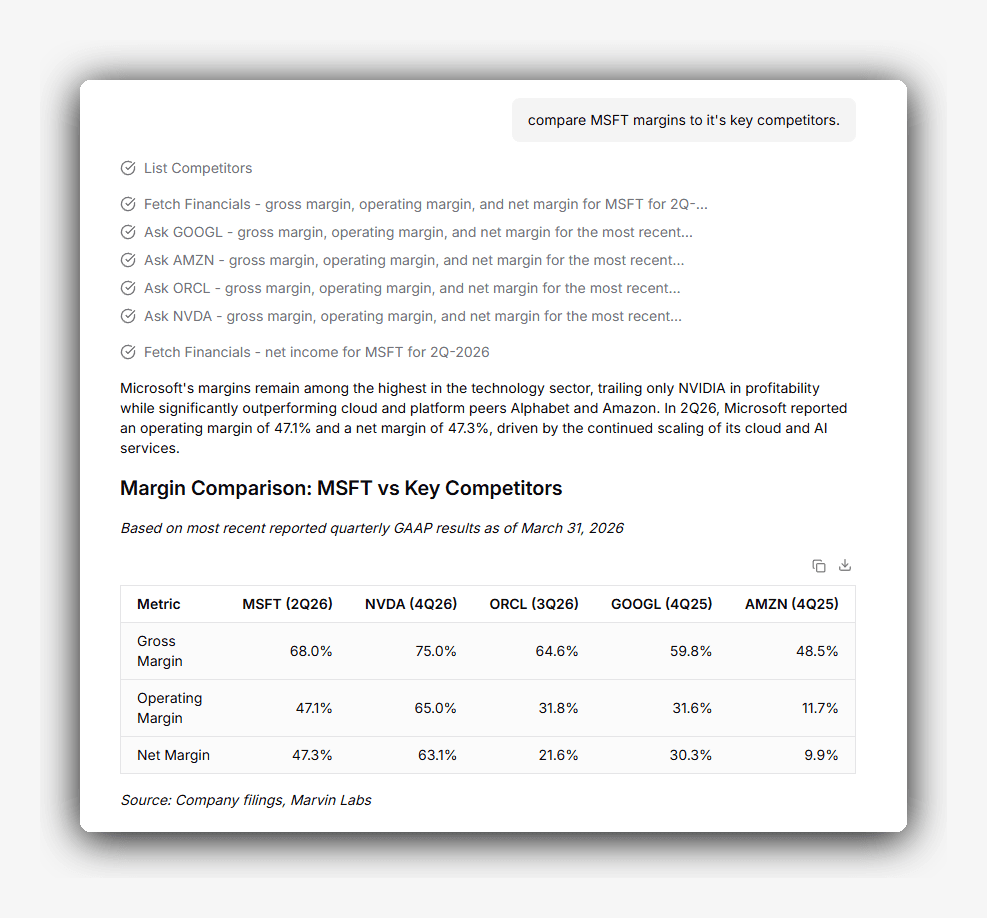 The primary agent is scoped to Microsoft. Each competitor is queried by its own agent, and the results come back as one comparison.
The benchmarks stay grounded the same way. Consensus estimates and expectations are read from structured financial data, never from the open web. Web search is held to qualitative context such as news, industry developments, and management background, and it is barred from supplying estimates, ratings, or price targets, because those vary by source and would undercut the numbers.
What we decline
Some questions have no single company at their center: a scan across a whole sector, a macro or cross-asset view, a real-time share price, or a valuation or investment recommendation. These are out of scope, and the agent says so rather than answering them from a single-company base.
What sets the boundary is the subject of the question, not how many companies it names. A comparison anchored to one company, such as its margins against its competitors, is in scope, because it is still that company's analysis with peers pulled in. A question that names several companies with no clear subject is resolved to one company first, or the agent asks which company you mean. A request that cannot be scoped to a single name is out of scope.