
Deep Research Agents
Deep Research Agents are AI assistants that run a defined research task end to end. Each agent reads a company's filings, earnings calls, and press releases, extracts the material points, and produces a structured output with every statement linked back to the source it came from. You can start one yourself, and you can set one to run on its own, either on a schedule or when a company publishes something new.
Marvin Labs supports a selected set of agents covering common analyst workflows. Users on the Pro Plan can additionally define custom agents tailored to their own research needs.
List of Deep Research Agents
The agents below are available to run now. Start one from the table, or read the per-agent detail underneath for what each produces and what it costs.
| Agent | Run |
|---|---|
Consolidated Earnings Summary Generates a comprehensive summary of earnings results for a company, analyzing financial performance, key metrics, and management commentary from earnings reports and conference calls. | |
Guidance Tracker Tracks the forward-looking guidance and expected events a company has shared across its filings, and shows how each one has changed over time, from when it was first given to where it stands now. | |
Guidance Performance (Long-Term) Reviews a company's past guidance against what actually happened, whether it beat, met, or missed each target, and rates its overall accuracy and track record. | |
Guidance Performance (Earnings) Reviews the guidance that came due at a specific earnings release, which targets it put to the test, and whether the company beat, met, or missed each one. | |
Tariff Impact Tracker Analyzes earnings reports, conference calls, and SEC filings to identify how the April 2025 tariff implementation is affecting company revenue, margins, supply chains, pricing strategies, and capital allocation decisions. | |
Common Ground Update Reads an earnings release against what the company has told the market over the past and pulls out only what is new. |
Consolidated Earnings Summary
Generates a comprehensive summary of earnings results for a company, analyzing financial performance, key metrics, and management commentary from earnings reports and conference calls.
Guidance Tracker
The Guidance Tracker shows the current state of every forward-looking commitment a company still has open, and how each one got there. It reads the company's filings and earnings releases over a lookback window (two years by default), extracts each piece of guidance and each expected event, and threads together the restatements of the same target so you see one coherent history per commitment rather than scattered mentions.
For each open thread, the agent narrates how the guidance moved over time: when it was first given, whether management later raised, narrowed, or lowered it, and where it stands now. A closing narrative summarizes how the overall guidance picture has shifted across the window.
Scope a run to a single earnings period to see only the guidance that period touched. In that mode each thread is flagged as new, meaning the period introduced it, or updated, meaning the period restated a commitment that already had prior history. Leave the period unset to see the full set of open commitments.
Every thread links back to the filings it was built from. For how guidance is extracted, standardized, and threaded across documents, see Guidance Tracking.
Guidance Performance (Long-Term)
Guidance Performance (Long-Term) scores how well a company has delivered on the guidance it gave, across a long history (five years by default). It takes the commitments that have since closed, finds what actually happened, and grades each one.
For metric guidance, each closed target gets a verdict of beat, met, or missed against the final guided figure. For expected events, each gets occurred, delayed, pending, or cancelled. A target with no comparable actual is left unscored rather than guessed. The verdict is judged against the company's reported actuals, and a verdict is only kept when a real actual backs it, so the grade reflects what was reported rather than what the model assumed.
The run then rates the company on two scores from 1 to 5:
- Accuracy: how closely outcomes matched the guidance, weighted toward the targets that mattered most.
- Discipline: how consistent and reconcilable the company's guidance practice has been over time.
An overall rationale cites the specific threads that drove the scores. This is the long-history view of a company's track record. For scoring tied to one reporting date, use Guidance Performance (Earnings). For the methodology behind the verdicts and scores, see Guidance Tracking.
Guidance Performance (Earnings)
Guidance Performance (Earnings) scores the guidance that came due at one specific earnings release. Where the long-term agent grades a company's whole track record, this one stays narrow: it grades only the targets that this quarter actually put to the test.
Select a company and an earnings period. The agent finds the commitments that resolve at that release: metric guidance whose guided period matches what the company is now reporting, and expected events whose window closes on or before the release. It evaluates each as of the earnings release date, so the verdict reflects what was known then rather than today.
Each tested metric gets a verdict of beat, met, or missed against the final guided figure, and each event gets occurred, delayed, pending, or cancelled. As with the long-term agent, a verdict is kept only when a reported actual backs it. The run also returns accuracy and discipline scores for the guidance this release resolved.
The period matching is reporting-aware, so a fourth-quarter release tests the full-year guidance it reports against. For the methodology behind the verdicts and scores, see Guidance Tracking.
Tariff Impact Tracker
The Tariff Impact Tracker estimates how the April 2025 U.S. reciprocal tariffs affect a single company. Select a company and the agent reads its filings and earnings calls, supplemented by web search, to find where management has discussed tariff exposure and what it has done about it.
The output separates two impacts and reports each as a money range:
- Revenue impact: lost sales and demand destruction attributable to tariffs, both already observed and forward-looking.
- Cost impact: the net hit to costs and profitability the company actually bears after its own pricing actions, cost reductions, and supply-chain adjustments.
Alongside the numbers, the agent narrates the qualitative picture: pricing strategy, supply-chain changes, and capital-allocation decisions management has tied to tariffs. It backs the analysis with up to three verbatim quotes from the source documents, each attributed to where it was said. When a company has no meaningful tariff exposure, the agent says so rather than manufacturing an impact.
The estimates are model-derived from what the company has disclosed, not read from a tariff schedule. They reflect the net effect management reports bearing, so a company that has fully passed tariffs through to price shows a smaller cost impact than its gross exposure would suggest.
Common Ground Update
The Common Ground Update reads an earnings release against everything the company has told the market before and reports only what is new. Pick a company, and optionally an earnings period; it defaults to the most recent one. The agent then compares the release with the company's common ground, the body of facts it has built up across past filings, releases and calls.
Most of an earnings release repeats what the market already knows. The same strategy slides, the same cost program, the usual quarter-on-quarter numbers. All of that gets filtered out. What remains falls into a few groups: statements that contradict or walk back earlier ones, plans and commitments appearing for the first time, material revisions to figures or timelines, and familiar plans whose timing moved.
The output starts with a short overview of the biggest changes, then lists the new facts by topic (strategy, guidance, capital allocation and so on). Each fact is grounded in the source documents of that release. If a release contains nothing new, the agent says so instead of dressing up routine results as news.
The first run on a company has to work through its document history, so it can take a few minutes. Later runs reuse that work and finish much faster.
How Agents Run
An agent runs in one of three ways: you start it, a scheduled report starts it, or AI Analyst Chat starts it as part of a conversation.
Manual Trigger
You start an agent yourself from the Deep Research Agents hub, the table above, from a company page, or from anywhere the run dialog is available. You pick the company or earnings period, set any optional inputs, and the agent produces its output and saves it to your recent runs.
Scheduled Report Trigger
A scheduled report starts an agent on its own, either on a recurring schedule or when a company publishes a new document. See Scheduled Reports below for how to set one up.
AI Analyst Trigger
AI Analyst Chat can decide to launch a Deep Research Agent straight from a conversation. The result appears inside the chat conversation, and is also available on its own from your recent runs.
Scheduled Reports
A scheduled report runs an agent without you starting it, either on a recurring schedule or when a new document arrives. Reports are set up at the top of the Deep Research Agents hub under New report. Each one has a name, an agent, a trigger, a set of companies, and an email preference.
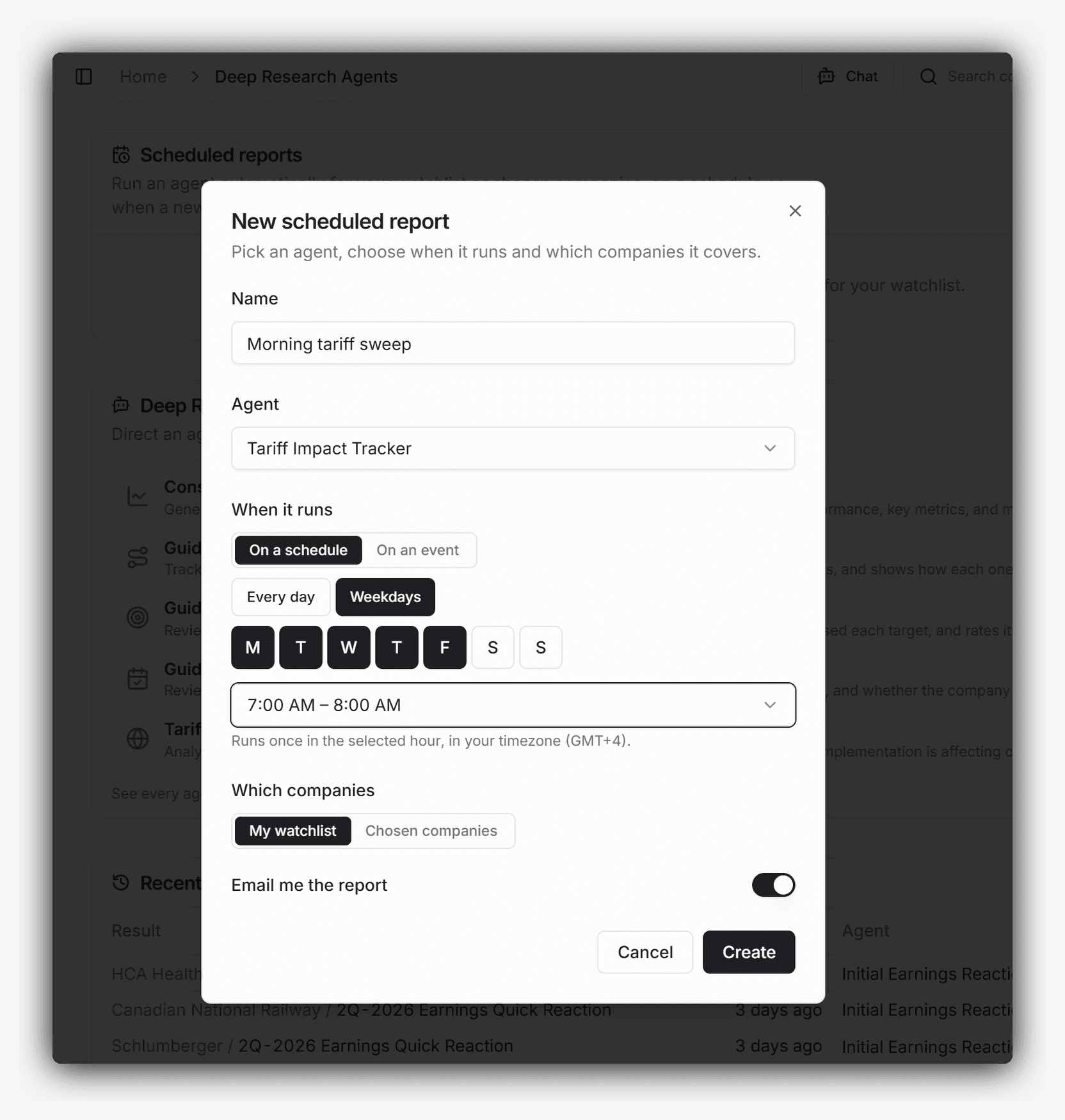 A report set to run the Tariff Impact Tracker across the watchlist every weekday at 7:00 AM, delivered by email.
A report starts one agent run per company in scope. A time-based report covering a 45 company watchlist starts 45 runs each time it triggers. An event-based report starts one run, for the company whose document triggered it.
Scheduled reports are available on the Standard and Pro plans. On the Evaluation plan, agents run manually.
On a Schedule
Choose the days of the week and the hour. Presets cover every day and weekdays, and individual days can be toggled on top of either preset.
Times are in your local timezone. A report runs once inside the selected hour rather than at an exact minute, so a report set to 9:00 AM runs between 9:00 and 10:00.
On an Event
An event-based report runs when a new document arrives for a company in scope. Four events are available, and any combination of them can be selected:
- New filing: Any new filing from a company in scope.
- Earnings press release: First step of the typical earnings release cycle. Triggers when the press release is filed or made available on the company's investor relations page.
- Earnings call transcript: Second step of the cycle. Triggers once the earnings call has concluded and the transcript is available, typically within minutes of the call ending.
- Earnings filing: Third step of the cycle, when the company issues its regulatory filing such as the 10-Q or 10-K filing, or the equivalent in the company's regulatory regime.
Note that not all companies follow this exact three step process. For example, in some jurisdictions the press release contains the full regulatory filing, in which case Marvin Labs treats such a document as an Earnings filing. Furthermore, earnings calls are typically voluntary, and some few companies elect to forego earnings calls.
Which Companies a Report Covers
A report covers either your watchlist or a list of companies you name.
A watchlist report reads your watchlist at the moment it runs, so companies you add to or remove from coverage are picked up automatically with nothing to reconfigure. A named list runs only against the companies you selected.
For event-based reports, this setting decides which companies are eligible to trigger the report rather than how many runs it starts. A watchlist report on the earnings call transcript event triggers once, for whichever watchlist company reported.
Delivery and Management
Every run appears under Recent runs on the Deep Research Agents hub, alongside the runs you started yourself.
"Email me the report" is on by default. Each completed run sends an email with the company and ticker in the subject line, a short teaser from the summary, and a link through to the full report. The full report, with its citations and in-context highlights, opens in the app.
Each report can be paused from the toggle on its row, edited, or deleted. Pausing keeps the configuration and stops the report from running.
Cost
Agents charge Marvin AI Credits in line with the actual token usage of each run, so a short, well-scoped run costs less than a long one that works through many documents.
For the full breakdown of how credits are calculated and consumed across Deep Research Agents and AI Analyst Chat, see Marvin AI Credits.