
Microtransactions are the gaming industry's most durable post-launch revenue mechanism, converting individual titles into long-duration earnings assets well beyond the box sale. The category is far less uniform than it appears. The mechanics sustaining it differ significantly in design intent, player psychology, and regulatory exposure — and recent legal pressure on Valve's loot-box ecosystem makes this a reasonable moment to examine what separates monetisation that holds up from the kind that doesn't.
Gaming's Most Profitable Friction
Few revenue mechanisms in modern media are as commercially important, or as politically exposed, as the microtransaction. That's not a coincidence. The same design choices that make certain monetisation systems effective revenue generators are precisely what draw legal and regulatory fire.
Microtransactions changed the fundamental economics of game development. For decades, publishers collected revenue once, at point of sale, and the relationship with the customer ended there. Live service models broke that logic entirely. Publishers built persistent, monetisable ecosystems around titles and turned post-launch engagement into a revenue stream that could run for years. In the best cases, annual in-game spend now comfortably dwarfs the box sale: the franchise economy around FIFA Ultimate Team, or the ongoing spend inside Genshin Impact, generates revenues no premium release could replicate. Investors have noticed. Game studios are increasingly valued less as hit-driven businesses and more as platforms with measurable lifetime value per user.
But the mechanics producing that revenue are not uniform. Some monetisation systems are genuinely additive: cosmetic purchases, battle passes, optional content that extends enjoyment without distorting progression. Others run on something different — opaque pricing, artificial friction, behavioural pressure, paid randomness. The distinction matters analytically. Systems built on compulsion or opacity may sustain headline revenue in the short term, but the risk accumulates quietly. Player trust erodes. Regulatory attention follows. Revenue quality, examined carefully, often looks less durable than the top line implies.
The immediate trigger for this piece is a legal challenge now working through U.S. courts, targeting Valve's loot-box mechanics on Steam. It is not the first time this type of design has drawn formal scrutiny, and it is unlikely to be the last. The case is a useful prompt to ask a question the sector has largely deferred: one of gaming's most profitable monetisation structures may also be one of its most vulnerable.
The Valve complaint
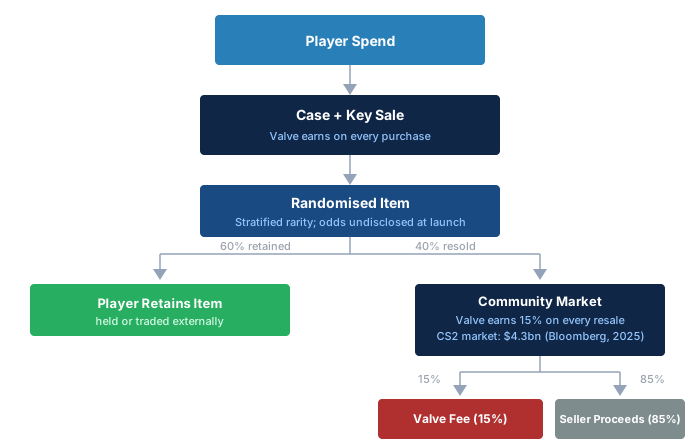
In February 2026, New York Attorney General Letitia James filed suit against Valve Corporation, alleging it has been operating an unlicensed gambling mechanism through the Steam platform. The action covers Counter-Strike 2, Team Fortress 2, and Dota 2. Players buy cases with real money; each yields a randomised item from a pool with stratified rarity. Odds of receiving the most valuable items are low and, until recently, were not disclosed within the game. The AG's legal theory rests on convertibility: skins won through cases trade freely on third-party markets at publicly visible prices, making them a "thing of value" under New York gambling statute — a construction built specifically to succeed where prior private litigation did not.
What makes this more than a complaint about opaque odds is the secondary market. Valve operates the Steam Community Market, a real-money exchange where players buy and sell items freely. Counter-Strike skins — knife finishes, gloves, certain weapon patterns — regularly trade for hundreds of dollars; Bloomberg estimated the CS2 skins market at $4.3 billion as of March 2025, and a single skin sold for over $1 million in 2024. That changes the nature of the transaction. A player opening a case is not simply hoping for a cosmetic to use in-game. They are paying for a randomised draw on an asset with an externally validated price. The reward carries real monetary value. It can be sold.
Valve's structural position is what makes the case analytically significant beyond its specific facts. Valve is the game developer, the platform operator, and the marketplace host. It earns a transaction fee on every item sold through the Steam Community Market. The full loop runs inside Valve's own architecture: the company designs item scarcity, sells the randomised access mechanism, hosts the secondary exchange, and clips a percentage on every trade. This is not a game studio that bolted on a revenue feature. It is a vertically integrated monetisation stack, and each layer feeds the next.
The case matters beyond Valve. Across the live-service sector, a material share of recurring revenue depends on mechanics that share structural characteristics with what the AG is now contesting: paid randomness, manufactured scarcity, items whose perceived value is sustained by community trading and status effects. A parallel federal class action — Flauto et al. v. Valve, filed in Washington weeks later by Hagens Berman — advanced similar claims with RICO-adjacent damages theory. On 9 April 2026, Judge John H. Chun granted an unopposed motion to consolidate the federal actions into a single multidistrict proceeding, In re Valve Loot Box Litigation (No. 2:26-cv-00788-JHC), and appointed Hagens Berman as interim lead class counsel. A consolidated complaint is due within 30 days of the order; Valve has 45 days to respond. The structured class proceeding that follows is not the same animal as the early-stage private litigation the industry has deflected before, and the parallel state action by the New York AG continues on its own track.
Why this is more than a lawsuit story
The action is brought by a state attorney general, with enforcement authority that prior private loot-box litigation did not have. It contests the legality of the monetisation design itself, not merely its popularity. It tests where U.S. regulators draw the line between gaming and gambling. And it targets an architecture that has shaped how dozens of other titles structure their post-launch economics.
From expansion packs to extraction loops
The baseline model for video game monetisation was, for most of the industry's history, simple. A publisher set a price. A consumer paid it. The transaction ended. Players might return for a sequel two or three years later, and an occasional expansion pack added content at a supplementary price. The relationship between spend and product was direct.
The first meaningful change came with downloadable content. DLC was not conceptually new — content sold post-purchase, much like an expansion pack — but digital delivery made it cheaper to produce and faster to release. Publishers shifted from large annual expansions to smaller, more frequent additions. The model started to look less like a single purchase and more like a subscription in all but name. Free-to-play games, initially a mobile and browser phenomenon, took that further: the upfront price could be zero, and monetisation could begin after the game was already installed.
What followed was a steady broadening of what publishers chose to sell inside games: cosmetic items, convenience boosts, in-game currencies, battle passes, event-limited content, card packs, gacha draws, loot boxes. Each represented a different implicit bargain with the player. But they arrived quickly enough, and were described loosely enough, that the industry settled on a single umbrella term for all of it. That term did more to confuse the debate than clarify it.
The more important change was not the volume of these systems but what they were built to monetise. Early DLC monetised content. Later systems monetised something less tangible: impatience, status, scarcity, and in the most aggressive cases, uncertainty. Buying a battle pass means paying for a structured content ladder with visible rewards. Opening a loot box means paying for a chance. Spending on a convenience boost means buying back time that the game's own design withheld. These are not variations on the same transaction. They have different economics, different player psychologies, and different regulatory risk profiles.
That is precisely why "microtransactions" has become too blunt a term for serious analysis. A cosmetic skin, a battle pass, a pay-to-win shortcut, and a resale-linked loot box do not belong in the same category. Treating them as equivalent obscures the mechanics that actually matter. Any rigorous assessment has to start with a taxonomy.
A taxonomy of in-game monetisation
Value accretive monetisation anchors one end — cosmetics, optional content, structured progression ladders — where spending is a free choice that adds rather than restores. Gambling-adjacent mechanics anchor the other: systems built around uncertainty, compulsion, competitive anxiety that spending can relieve but not resolve. Friction and extractive monetisation occupy the middle, and that is where most of the analytical complexity lies. It is also where the gap between durable and fragile revenue is most easily obscured by headline recurrence figures.
These four categories are not organised by price, spend frequency, or platform. The distinguishing variable is more fundamental: what is the mechanic built to monetise, and does the transaction add to the player's experience or extract value from a state of discomfort, scarcity, or uncertainty? The taxonomy classifies implementations, not mechanic names — a battle pass built on genuine content progression sits in a different column from one that monetises artificial expiry pressure. The answer produces a spectrum more useful for analysis than any surface-level free-to-play versus premium split.
| Category | What it monetises | Typical mechanics | Revenue quality | Regulatory exposure |
|---|---|---|---|---|
| Value accretive | Expression, identity, optional access | Cosmetic skins, battle passes, optional DLC | High | Low |
| Friction monetisation | Impatience, time, progression speed | Convenience boosts, XP accelerators, energy refills | Medium — degrades as friction is engineered more aggressively | Medium |
| Extractive monetisation | Competitive anxiety, FOMO, compulsion | Pay-to-win, grind bypass, whale-targeted pricing | Low to medium — concentrated spend, churn risk | Medium–High |
| Gambling-adjacent | Uncertainty, hope, chance | Loot boxes, gacha, card packs with resale value | Appears high; structurally fragile | High–Very High |
The real buy-side question is therefore not whether a company uses microtransactions, but what class of monetisation it relies on, how central it is to earnings, and how exposed it is to regulation, sentiment decay, or design fatigue.
Players, publishers, platforms, regulators
Players are not passive victims of in-game monetisation, and the analysis suffers when they're treated as such. Free-to-play and live-service games genuinely deliver value that premium titles often don't: lower or zero upfront cost, regular content that extends the lifespan of a game already enjoyed, cosmetic systems that let people express identity and participate in community. For many players, the optional spend is genuinely optional, and a regular content cadence keeps the game feeling alive rather than static.
The costs are real too. Cluttered economies, persistent spend pressure, UI built to surface purchase opportunities ahead of gameplay, and the gradual fatigue of feeling perpetually one transaction behind — these are what turn tolerance into resentment. The gap between a system that offers value and one that manufactures discomfort to relieve it is usually invisible in revenue reporting. It shows up in sentiment data and community health, and eventually in engagement numbers.
For publishers, live service economics changed the shape of the business. A premium title earns in a compressed window around launch, then declines. A live service title can sustain meaningful spend for years, and in the most successful cases the post-launch economy comes to dwarf the box sale entirely. The existential anxiety of launch week becomes less acute when a title has built a monetisation engine with its own momentum.
LTV per engaged user is the metric that follows — and the one buy-side investors should weight most heavily when assessing franchise durability. But LTV is not uniform. A franchise monetised on player goodwill and voluntary cosmetic spend looks different from one where LTV depends on whale concentration and behavioural pressure. Both may report strong recurrence. Only one is durable.
The platform layer is where the incentive picture gets structurally interesting. Steam, PlayStation Network, the App Store, and Google Play all earn a percentage of every transaction flowing through their ecosystems — from transaction intensity as much as game sales. A platform with a live secondary marketplace, as Valve has, also captures fees on resale. The platform's financial interest is in sustaining spend and trading volume, not just game quality. That is a meaningfully different incentive from the one publishers have, and it rarely gets sufficient attention in sector analysis. Valve takes this to its logical extreme — developer, platform, and marketplace operator simultaneously — which is what makes its legal exposure categorically different from that of any other platform in the sector.
Regulators arrive from a different direction. Their concern is consumer protection — and increasingly the specific exposure of minors to systems that share design characteristics with gambling. Belgium and the Netherlands have already classified certain loot box mechanics as gambling under existing law. The New York complaint against Valve is a more aggressive version of the same argument: that randomised spend tied to real-money secondary markets may sit outside the protected space the industry has long assumed it occupies.
Investors have to hold all of this simultaneously. A title reporting strong live-service recurrence may be doing so on genuine value and player goodwill — or on concentrated spend, behavioural mechanics, and opaque design that carries fragility the topline does not show. The monetisation class matters. So does regulatory direction. Recurring revenue built on mechanics under active legal contest is a different category of asset from recurring revenue that isn't.
Why the model is so attractive
The metrics live-service models generate are why investors pay attention. ARPU compounds over time in a way that a box sale never can. Monthly active users and revenue per paying user imply durability that launch-week sales do not. Valuation multiples follow: a publisher with a healthy live-service title starts to look less like a film studio and more like a subscription platform — recurring, predictable, with embedded switching costs. That analogy has limits, but it explains the premium the market has historically awarded these businesses.
Bad recurrence sustains itself through a specific set of mechanics. Friction engineering creates a sense of falling behind that spending relieves. Opaque pricing makes individual transactions harder to evaluate rationally. Behavioural pressure turns not spending into a felt penalty rather than a neutral choice. Players subject to these systems don't return because the game has earned their loyalty. They return because the architecture has made leaving more expensive than staying. That is a different foundation for recurring revenue, and the difference matters when the pressure eases — through a design change, a competitor's release, or accumulated fatigue.
The headline recurrence figure also tends to obscure who is actually paying. Many live-service models — particularly free-to-play and gacha-heavy titles — are not monetising the average engaged player. They are monetising a small high-spend cohort.
A title with millions of monthly active users and strong ARPU may be deriving most of that ARPU from a few percent of its base. If that cohort fatigues or churns, the revenue profile can shift quickly. A game can look highly monetised and still be fragile.
Trust is not a soft variable. It affects conversion rates, retention, player tolerance for future monetisation, and community reception of new content. Destiny 2 makes the point. When Bungie vaulted older paid content — removing expansions players had already purchased — the backlash was significant and it lasted. The franchise kept generating revenue, but the damage became a headwind: players grew less willing to spend on future content, more critical of new monetisation decisions, and less forgiving of subsequent missteps. By 2024, engagement had declined enough to prompt significant restructuring at Bungie. The franchise spent trust it could not replenish, and the erosion turned out not to be a communications problem. It was an economic one.
The strong monetisation models are those where recurrence compounds alongside player goodwill. The weakest are those where recurrence is purchased at the expense of trust and therefore contains the seed of its own reversal.
The Durability Trap: A Bungie Case Study
The $765 million impairment loss recorded by Sony in May 2026 is not an isolated accounting event; it is the financial realisation of the durability trap. As shown in the table below, the collapse of Destiny 2's engagement velocity following the 2024 Final Shape expansion provides a textbook example of what happens when a studio exhausts player goodwill to meet short-term recurrence targets.
Source: Steam Charts. Peak concurrent players per calendar quarter.
The franchise has continued in a direction that sharpens rather than softens the original point. Renegades, the Star Wars-themed expansion released in late 2025, launched with the lowest day-one Steam concurrent player count in Destiny 2's history despite broadly positive critical reception. The follow-up major update, Shadow and Order, was delayed from March to June 2026, "undergoing large revisions" and renamed in the process. PC concurrent players have reportedly fallen by approximately 91% since the Edge of Fate baseline. Sony has booked a $765m impairment loss tied to Bungie for the financial year.
The natural follow-up question is whether Bungie's resource allocation toward Marathon, the extraction shooter released in March 2026, has produced a substitute asset capable of carrying the studio while Destiny 2 contracts. The early data does not support that reading. Marathon peaked at roughly 88,000 concurrent Steam players at launch in March, fell 71% within a month, and by mid-May was sustaining peaks closer to 11,000–16,000 — below the top 100 most-played titles on Xbox, with no meaningful PlayStation traction. Reported development cost was over $250m. The hypothesis that resources were being prudently redirected from a mature live-service title to its successor presupposes the successor lands. As of the time of writing, it has not.
The point is not that Destiny 2 is dying — live-service titles can carry diminished bases for some time. It is that the asset is now visibly demonstrating what the piece argued in the abstract. Recurring revenue built on architecture that engineered fatigue rather than goodwill does not simply slow when sentiment turns. It accelerates downward, and the studio's capacity to compensate with a new title is not an automatic offset — particularly when the new title's own retention curve mirrors the problem being diagnosed. The Bungie case is the closest thing the sector has to a controlled experiment for the durability question this piece set out to frame.
What this means for the coverage universe
For some businesses in the coverage universe, monetisation architecture is not a peripheral feature of the investment case. It is the investment case. Publishers where live-service recurring spend accounts for a material share of both revenue and operating leverage are those where the framework in this piece applies most directly. For these companies, the quality of that spend — which mechanics sustain it, how concentrated the payer base is, how exposed the design is to regulatory challenge — is inseparable from earnings quality. A change in monetisation design, a regulatory ruling in a key market, or a deterioration in player sentiment is not an operational footnote. It is an earnings quality event. Take-Two Interactive, whose post-launch economics will be shaped by GTA VI's monetisation design to a degree that dwarfs any other publisher event in the near-term coverage horizon, belongs here too, as do certain mobile-first publishers.
A second group carries meaningful live-service exposure but retains substantial earnings explanatory power elsewhere — through premium release cycles, catalogue depth, or diversified genre exposure. For these publishers, the risk from aggressive monetisation design is real but less concentrated. Ubisoft operates across both premium and free-to-play models, meaning monetisation quality concerns can affect margin and franchise value without threatening the whole model. Nintendo carries live-service exposure alongside a premium release cycle and hardware economics that provide considerable insulation. For this group, the question is what proportion of company value depends on monetisation quality, and how sensitive that proportion is to regulatory or sentiment shifts.
Publishers less dependent on aggressive recurring spend are not immune. Industry-wide regulatory change affects the sector, not just the most exposed operators. Platform governance changes — a console manufacturer imposing odds transparency requirements, or an app store enforcing spend controls on minors — create compliance costs across the board. Consumer expectations, once reset by a high-profile legal case, tend not to reset back. Capcom and CD Projekt Red are cases where premium monetisation still anchors the investment thesis, but the sector-wide direction of travel is worth watching for longer-run multiple assumptions.
The platform layer warrants a separate investment consideration. Valve's exposure is categorically different from that of other platform operators: it occupies the developer, platform, and secondary marketplace positions simultaneously, with fee revenue running through all three. A ruling against Valve does not straightforwardly translate into equivalent exposure for Sony, Microsoft, Apple, or Google — none of them operate secondary markets or design the games generating the contested spend. But platform governance changes carry their own compliance costs, and a market-wide shift in how randomised spend mechanisms are regulated will require app store and console platform policy responses regardless of direct legal liability. Platform holders that have built revenue models around transaction volume are running a different risk from the one publishers face, but they are not running no risk.
Regardless of where a company sits on that spectrum, the following merit monitoring:
- Shifts in management language on monetisation — from defending current mechanics to flagging design reviews
- Recurring consumer spend disclosures, particularly changes in live-service versus premium revenue granularity
- Legal or policy escalation around loot-box or pack mechanics in major markets
- Moves toward direct-purchase cosmetics or battle passes away from randomised systems
- Player-fatigue signals: engagement data, community sentiment, third-party tracking
- Voluntary odds transparency disclosures as a proactive compliance signal
- Youth-protection spend controls, and whether introduced voluntarily or under regulatory pressure
- Marketplace restrictions imposed by platform holders
Electronic Arts: the thesis in concentrated form
Few companies in the coverage universe illustrate this piece's central argument as directly as EA. Ultimate Team — the card-pack system at the centre of EA Sports FC, Madden, and other franchise titles — is one of the most prominent recurring revenue engines in the sector, and among the most directly analogous to the mechanics under scrutiny in the Valve litigation. EA has already absorbed regulatory consequences: Belgium and the Netherlands ruled Ultimate Team packs to constitute gambling and required their removal from those markets. The revenue impact was manageable, but the precedent was established.
EA is not a caricature of extractive monetisation. Apex Legends runs on a battle pass and cosmetics model that sits toward the value-accretive end of the taxonomy in this piece. The company has adapted designs in response to prior scrutiny and operates at a scale that can absorb compliance costs that would damage smaller publishers. But scale is not immunity. A material extension of the Valve case logic — to card-pack systems broadly, or to any randomised spend mechanism linked to a secondary market — would land directly on EA's most profitable recurring revenue stream.
That framework has acquired sharper relevance since the September 2025 announcement of the $55bn sponsor take-private led by PIF, Silver Lake and Affinity Partners, expected to close by the end of Q1 FY27. The conventional commentary on the buyout has emphasised relief from quarterly disclosure pressure and longer development horizons — both genuine. The under-discussed corollary is that private ownership removes the public-market constraints that had begun to discipline monetisation design, while adding one in the other direction: the cash flow servicing $20bn of LBO debt has to come from somewhere. Going private may, paradoxically, escalate the very monetisation aggression public markets had begun to restrain.
Conclusion
The Valve complaint is a prompt, not the central issue. The central issue is that a significant share of live-service recurring revenue has been valued as if its durability were equivalent regardless of what mechanics produce it. It isn't. The mechanics matter — to regulatory exposure, to payer concentration, to what happens when the architecture eases or faces legal challenge. That fragility was always present. The case makes it visible.
The taxonomy developed across this piece makes the distinction precise. Value-accretive spend compounds with player goodwill. Gambling-adjacent mechanics carry structural fragility that headline recurrence figures don't show. Friction and extractive monetisation sit between them, which is where most of the earnings quality debate actually lives. The framework needs no moral position. It needs a more accurate read of what recurring revenue is built on.
Prior industry assumptions are now being tested in courts, not argued about in trade press. Belgium and the Netherlands established precedent. A state attorney general has now filed suit. A parallel federal class action followed weeks later. Regulatory direction has been consistent in Europe and is hardening in the U.S., even where enforcement has lagged. Publishers that structured their post-launch economics around randomised spend mechanisms are carrying risk that is materialising in legal terms now. So are the platforms that built revenue models around transaction volume and secondary marketplace activity. That is a different kind of exposure than the sector has managed before.
The question for investors is not whether microtransactions are defensible. It is whether the specific mechanics generating the recurrence they are pricing will still be legal in the markets that matter.
