
Prologue — The Survey Commissioned
In 1086, twenty years after the Conquest, William sent his commissioners into every shire of England to record what a generation of castle-building had actually produced. Who holds this land. By what right. What it was worth before, what it is worth now, and — in folio after Yorkshire folio, in a single repeated Latin word, wasta — what had been laid waste in the taking. The English came to call the book Domesday, because like the day of judgement it admitted no appeal. But the name flatters the crown's intentions. The survey did not judge. It recorded. It converted twenty years of occupation, seizure, and improvisation into entries in a ledger, and in doing so it told the truth about the Conquest more completely than any chronicle: here is what was claimed, here is the paperwork it acquired afterwards, here is what the claiming cost.
What follows is a survey of that kind, conducted on Nintendo.
The reason a medieval instrument suits a modern subject is that the conditions match. Castles proliferated in eleventh-century Normandy during the years when ducal authority was weakest — William's own minority — and they proliferated because of what a castle is. A castle reads as a defence. It works as a declaration — a claim to jurisdiction made visible, raised precisely where no higher authority could adjudicate it, relying on the fact that a standing fortification settles arguments that a legal right merely enters. The fortification preceded the right, and frequently produced it. Intellectual property law in the games industry is a landscape of exactly this kind — slow, ambiguous, contested, expensive to invoke and glacial to clarify — and in such landscapes, patent filings and litigation do not simply defend existing rights. They construct the practical effect of rights that may never be tested, in the shadow of an authority that arrives, when it arrives at all, years after the walls have done their work.
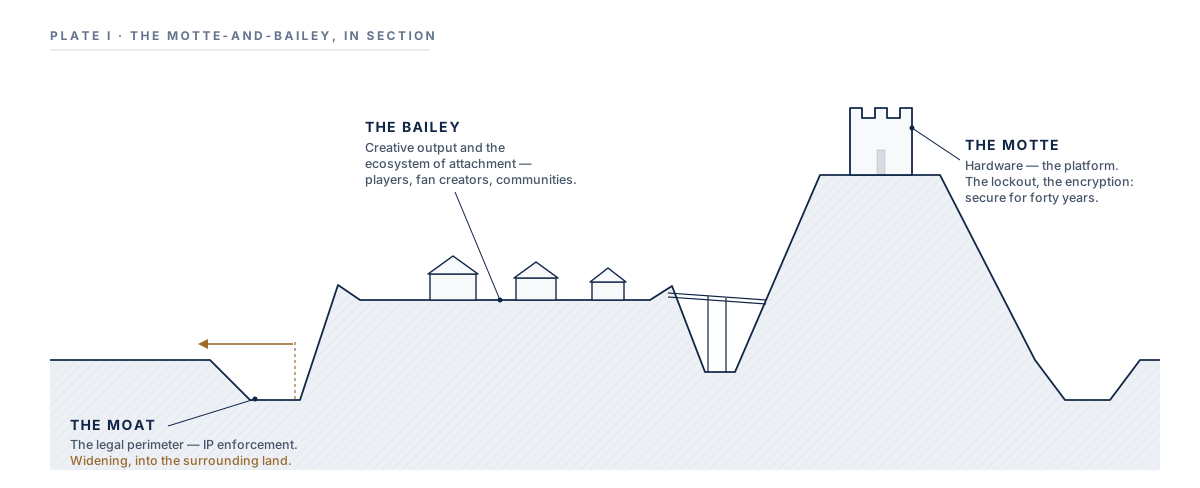
The survey needs two terms, and they are in the title. The bailey is the enclosed ground where life actually happened — in Nintendo's case, the creative output of half a century and, just as materially, the ecosystem of attachment around it: the players, the fan creators, the communities whose devotion converts a games catalogue into a culture. The moat is the legal perimeter dug around that ground, and the subject of this piece is the observable fact that the perimeter has been widening. One further term will recur: the castellan — the appointed keeper of a lord's walls, an officer whose trade is the fortification itself, and whose interest in the walls' extension is not always the lord's. Medievalists will note a substitution — the historical structure was the motte-and-bailey, the motte being the mound that bore the keep, the moat merely the ditch at the boundary. The substitution is the argument. Nintendo's mound is secure; what the company has been extending, year over year and jurisdiction over jurisdiction, is the ditch.
A survey is not a verdict, and none will be entered here. The distinction between defending the bailey and expanding the moat will be made to do the analytical work, and Nintendo will be measured only against its own ideal — a company with an unusually explicit code, proclaimed for forty years, against which its conduct can simply be read. The commissioners will ride first through Nintendo's own lands, from the earliest walls to the newest works, and then into the neighbouring realms — one of which, a fruit-bearing duchy on the Pacific coast, readers of this publication's survey of the mobile kingdoms will already know intimately — before the findings are entered in the book. What is held. By what right. And what, in the taking, was laid waste.
I. The Anarchy and the First Castles
Return, then, to Normandy in the years of William's minority, and look closer at the anarchy the prologue passed over in a sentence. The boy-duke's guardians were murdered in sequence — a steward, a tutor, a count — and while the court consumed itself, the local strongmen did the rational thing: they fortified. Authority existed on parchment and almost nowhere else; private castles rose across the province without licence or oversight, each one converting a family's ambitions into a permanent fact of the landscape. What matters for our purposes is not the anarchy itself but what happened after it ended. When William came of age and broke his rivals at Val-ès-Dunes in 1047, order returned to Normandy, and the castles of the defeated were duly pulled down. The victors' walls were not. Fortification itself — the practice, the architecture, the assumption that power wears walls — outlasted the emergency by centuries, because a wall built in a crisis does not know the crisis is over, and neither, it turns out, does its owner: emergency architecture has a way of becoming the constitution.
Nintendo's anarchy was 1983. The North American games industry, glutted with shovelware and abandoned by retailers who had been burned by unsellable inventory, collapsed by more than ninety per cent in two years; the conventional wisdom held that home video games had been a fad, like CB radio, and were over. When Nintendo brought the NES to America in 1985, it was entering a territory whose governing authority — ordinary market discipline, the trust between shelf and customer — had simply ceased to function. And its answer to that anarchy was, first and foremost, a wall.
Inside every NES console sat a chip Nintendo called the 10NES; inside every authorised cartridge sat its twin. On power-up the two ran a synchronised authentication — a lock and a key exchanging a continuous stream, each verifying the other's behaviour — and if the cartridge could not keep up its end of the conversation, the console reset itself, over and over, once per second: the blinking screen that a generation of players learned to interpret as a dirty connector was, in fact, the sound of a portcullis refusing to rise. The chip was patented — United States Patent 4,799,635 — and its program was copyrighted, and the combination is what made it more than an engineering device. To make a cartridge that ran on the NES, you had to get past the 10NES; to get past the 10NES, you had to reproduce or circumvent Nintendo's protected code; and so a technical handshake quietly converted the act of selling a game for a games console into something requiring Nintendo's legal permission; market access became licensed access, and the wall was the law.
And the licence, for those who took it, was a charter of vassalage in all but name. Nintendo manufactured every licensed cartridge itself, at prices it set, in quantities it approved. Licensees were limited to five titles per year. Content passed Nintendo's approval. Titles were exclusive to the NES for two years. Publishers who had operated as free agents in the Atari era — and whose overproduction, in Nintendo's telling, had caused the crash — now operated as tenants, and the extraordinary thing is that the arrangement was defensible, even popular. The crash was real; the discipline worked; the shelves could be trusted again. The first castle went up in a genuine emergency, with the peasantry's genuine consent. What should hold the reader's attention is the sequel. The crash ended. The lockout did not. There has not been a Nintendo console in forty years without an authentication wall at its gate, through boom and bust, monopoly and also-ran status alike — the emergency architecture carried forward, generation after generation, as the constitution of the platform.
The wall was tested in court almost immediately, and the results are worth more precision than they usually receive, because the entire subsequent posture rests on them. Atari's publishing arm, Tengen, tried two gates at once: it built a chip that mimicked the 10NES handshake, and — the fatal move — it obtained Nintendo's actual source code from the US Copyright Office by falsely claiming it was already a defendant in an infringement suit and needed the deposit for litigation. When the dispute reached the Federal Circuit in 1992, Nintendo won, and Atari Games Corp. v. Nintendo entered the industry's memory as the great vindication of the lockout. Read the opinion, though, and the vindication is narrower than the memory. The court accepted, in principle, that reverse engineering a system to understand what compatibility requires can be fair use — the intellectual work of studying the wall is not itself trespass. Atari lost, substantially, because it had lied to a federal agency: unclean hands tainted the defence it might otherwise have run. And in the same season, in Sega v. Accolade, the Ninth Circuit confirmed the principle cleanly — a rival who reverse-engineered Sega's console honestly, in a clean room, was protected, and the games it shipped without Sega's permission were lawful. Put the two cases side by side and the legal foundation of the lockout era looks contingent, even accidental: the fortress prevailed against a burglar, not against a surveyor, and the surveyors won their case next door. Nintendo's enforcement posture in the decades that followed has carried itself as though Atari settled everything. It settled far less than the walls suggest.
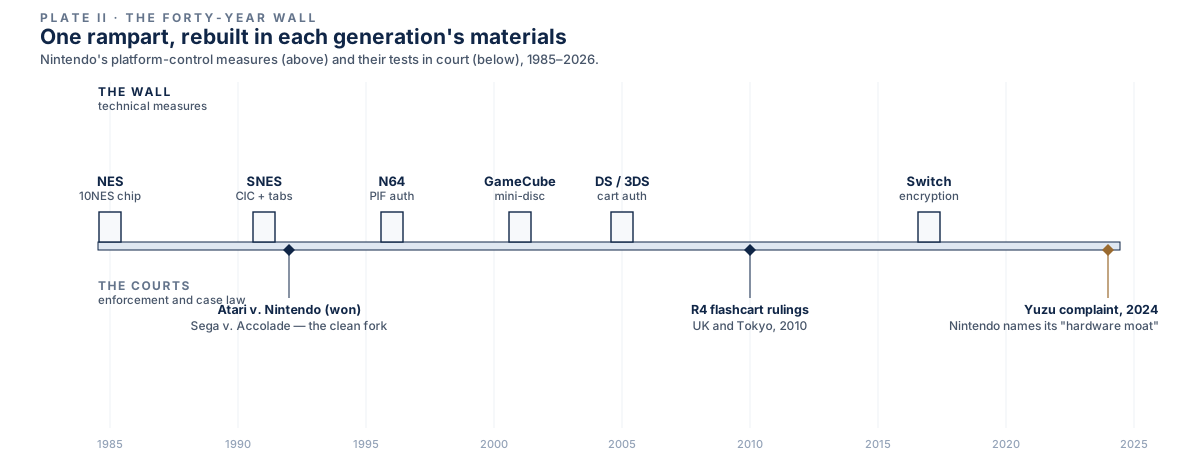
The wall itself, meanwhile, simply kept being rebuilt in each generation's materials — a lockout chip in the SNES with regional variants and, for good measure, plastic tabs moulded into the cartridge slot; an authentication processor in the Nintendo 64; a proprietary miniature disc format in the GameCube, unreadable by standard drives; and, when the DS era replaced cartridge cloning with flash carts, litigation across three jurisdictions against the R4 devices that carried them, with courtrooms in London and Tokyo both handing Nintendo victories — the English High Court, in 2010, dismissing the argument that the devices had lawful uses with the observation that infringement did not require them to be the only use. The Switch generation moved the wall from silicon into mathematics: modern Nintendo hardware enforces its boundary through encryption, the games unreadable without keys the console alone is licensed to hold. It has not all been intensification — the Switch abandoned region-locking, a genuine and creditable relaxation after three decades of walled markets — but the perimeter's logic has never once lapsed: forty years, six generations, one continuous rampart.
Nintendo knows what it built, and says so in its own voice. In a complaint filed in an American federal court in early 2024 — the campaign it opened is the subject of a later section — the company's lawyers described its games and hardware as an integrated system, and characterised the offence before the court as software being decoupled from Nintendo's hardware moat. The subject of this survey, in other words, has adopted the surveyor's vocabulary; the metaphor in this piece's title appears, unprompted, in the company's own pleadings. That is the fortification, then: raised in a real emergency, ratified by a narrower verdict than its reputation, rebuilt in every generation's materials, and named, by its own castellan, for what it is. What remains to be entered in the record, before the audit rides out to the perimeter, is what the lord says the walls are for.
II. The Chanson — Nintendo's Code
Chivalry was written by the knightly world itself — sung in its halls, preached at its councils. It emerged because the mounted warrior class was predatory, and required a code to legitimate its violence. The Peace and Truce of God, the earliest scaffolding of the code, were the Church's attempt to bind a class that was looting the countryside it claimed to protect; the chanson de geste gave that class a self-portrait it could aspire to, and mostly believed. That is the thing to understand about a legitimating code: it is rarely cynical. It is sincere, it is sung with feeling, and its function is to make a monopoly on force legible as guardianship. Before this survey audits Nintendo's conduct, it must enter Nintendo's code into the record — because the code exists, it is unusually explicit, it has been proclaimed with remarkable consistency for forty years, and every line of it is, as far as anyone can tell, sincerely meant.
Begin with the emblem. When Nintendo rebuilt the North American games market after the 1983 crash, it stamped a small gold starburst on every licensed cartridge: the Nintendo Seal of Quality. The consumer-facing promise ran, for decades, in almost unvaried words: "This official seal is your assurance that Nintendo has reviewed this product and that it has met our standards for excellence in workmanship, reliability, and entertainment value." Hiroshi Yamauchi, the president who built the regime, spoke of maintaining a "taste level" — no shoddy work, no broken products, nothing unworthy of the household the box would enter. The Seal is the purest artefact in this entire record, because the promise and the mechanism are the same object. To the customer it reads as a guarantee. To the licensee it was the visible face of a licensing regime that controlled what could be made, how much of it, and on whose terms. Quality-as-promise and control-as-instrument, indistinguishable by design — hold that double image, because the whole piece lives inside it.
The code found its fullest voice in Satoru Iwata, and his register repays quotation. At GDC in 2005 he introduced himself with a line that became the company's informal creed: on his business card he was a corporate president, in his mind a game developer, but in his heart, a gamer. When the Wii U's failure crushed profits in 2014, he cut his own salary in half rather than cut staff, and gave his reasoning plainly: "If we reduce the number of employees for better short-term financial results, employee morale will decrease, and I sincerely doubt employees who fear that they may be laid off will be able to develop software titles that could impress people around the world." And when Nintendo finally, reluctantly, took its characters to smartphones in 2015, he framed even that concession as guardianship: "We have no intention at all to port existing game titles for dedicated game platforms to smart devices because if we cannot provide our consumers with the best possible play experiences, it would just ruin the value of Nintendo's IP." Read those three statements together and the shape of the code is complete: craftsmanship over volume, the long relationship over the short result, and the IP held in trust — a thing that can be ruined by mishandling, like an estate, like a name.
Where Iwata supplied the governance, Shigeru Miyamoto supplied the theology. His public vocabulary has barely changed across four decades: delight, surprise, curiosity. "The obvious objective of video games is to entertain people by surprising them with new experiences," runs one characteristic formulation; inside every adult, another insists, is the heart of a child. His games, he has always maintained, are toys rather than scripts — things handed to players to explore, not performances they are permitted to watch. It matters that this is the company's philosophical core, because a toy, once handed over, invites exactly the behaviour whose punishment the middle sections of this piece document.
And the code does address the players directly. The rhetorical posture of a Nintendo Direct is host to guest — welcome, here is what we have made for you — a register of selective, curated generosity that no other platform holder has ever quite matched. In 2018 the company even codified its hospitality toward fan creativity, in Network Service Guidelines whose preamble begins: "Express yourself creatively by sharing your own original videos and images using content from our games. As long as you follow some basic rules, we will not object..." Note the architecture of that sentence — the warmth up front, the sovereignty in the subordinate clause. The basic rules, and who writes them, are the hinge on which everything that follows turns.
One more witness, from after the singing stopped. Reggie Fils-Aimé, the company's most visible Western executive for fifteen years, spent his tenure performing the code as fluently as anyone alive — and in 2022, in retirement, responding to reports about the treatment of contract QA workers, he offered a quieter line: this was not, he said, the Nintendo he had left. It is a small remark, tied to a specific labour dispute, and it should not be inflated beyond its context. But it is the first entry in this survey from inside the hall, and it names the possibility the remaining sections will test: that the chanson and the conduct have come apart. The song, to be clear, is still sung beautifully. Sincerity was never the question. The question — the only question an audit can ask — is whether the lord's obligations run in both directions, and the record of that begins outside the walls, where the fans live.
III. The Conquest of New Lands
The Normans who crossed in 1066 were a few thousand men proposing to hold a country of perhaps two million, and the mathematics of that proposition were solved by architecture. Within five years there were castles in every county town in England — most of them the timber motte-and-bailey, a fortification whose genius was speed. A mound, a ditch, a palisade: weeks of forced local labour, and a garrison of thirty could dominate a district that would have required an army to hold in the field. And the crucial fact about these structures is that the governed had never seen them before. The Anglo-Saxons did not build castles; they had burhs, communal fortifications, walls that belonged to towns. The private fortress — jurisdiction made of earth and timber, answerable to no local custom, looming over a population that had no institutional vocabulary for it — was an imported technology of control. At home in Normandy, the duke operated inside a settled web of obligation: peers, courts, the Church, the slow accumulated law of the province. In England he needed none of it. That is what conquest means: the place where your instruments work and the local settlements do not.
Nintendo's equivalent of the timber motte is a legal instrument most of its targets encounter exactly once, and it is worth explaining properly, because its speed is the entire point. Section 512 of the Digital Millennium Copyright Act offers hosting platforms a bargain: immunity from their users' copyright infringements, on condition that they remove allegedly infringing material "expeditiously" upon notice from a rightsholder. Read that bargain from the platform's side and its consequence is obvious. The notice is not a lawsuit; no judge ever sees it; nothing in it has been tested or proven. But the platform's safe harbour — its entire legal viability — depends on prompt compliance, and the platform is protecting itself, not its uploader. So the material comes down at the speed of an email being processed, and the burden of resurrecting it falls on the accused, via a counter-notice procedure whose practical meaning is an invitation to be sued by Nintendo in federal court. For a hobbyist who has spent years on a labour of love, that is no invitation at all. The takedown notice is the timber motte: cheap, fast, raised in days, requiring no siege engine of proof — and utterly effective against a population with no walls of its own.
The summer of 2016 showed the machinery working at scale, and the two cases that defined it are worth telling with their dates attached. Pokémon Uranium was a fan-made Pokémon game, nine years in development by a two-person team, released in August 2016 to an ecstatic reception: roughly one and a half million downloads in its first week. Within days of those numbers making the gaming press, letters arrived from attorneys representing Nintendo, and the developers withdrew the game. The same month — August 2016, timed by its creator to the thirtieth anniversary of the Metroid franchise — a lone Argentine developer released AM2R, Another Metroid 2 Remake, a decade-long reconstruction of a 1991 Game Boy title that Nintendo had left untouched for twenty-five years. It was received, immediately and widely, as one of the best Metroid games ever made. The takedown notices arrived within days of release; the following year, Nintendo shipped its own remake of the same game. Note the common structure. Neither project was enforced against during its years of quiet development, both were known to their communities long before release, and both fell at the precise moment of maximum public success. The offence that drew enforcement was success itself.
If that reading seems uncharitable, the record supplies a witness who states it as policy. Don McGowan, for years the chief legal officer of The Pokémon Company — and the attribution matters here, because Pokémon enforcement is led by TPC, the joint venture, rather than by Nintendo directly — described the trigger in terms that require no gloss: "The worst thing on earth is when your 'fan' project gets press, because now I know about you." Visibility, not harm, is the tripwire. Set that against the strategy Nintendo's own investor materials have proclaimed for years — that the fundamental aim is "expanding the number of people who have access to Nintendo IP" — and the two statements resolve only one way. Access is the strategy and access is the offence, and the difference between them is who controls the point of contact. The moat is drawn around the gate.
There is a second thing the 2016 cases reveal, quietly, and it will matter when this survey reaches Nintendo's home province. Both fan projects grew in ground Nintendo had left fallow — a franchise entry unremade for a quarter-century, a fan sequel filling years between official releases. The pattern generalises: an enormous share of the enforcement record's targets are projects that existed because official supply was withheld — out-of-print catalogues, untranslated releases, abandoned franchises. The company restricts supply, the commons fills the gap, and the filling of the gap is enforced against. Whether that sequence protects creative work or protects the commercial conditions around it is a question best answered where the tolerance is visible, and it is deferred to the section on the home duchy.
Not every village fell. The developers of TemTem and the Nexomon series — commercial studios operating openly in the monster-catching space — have navigated a decade in Pokémon's shadow without a notice or a writ, and the manner of their survival is instructive: conspicuous differentiation, careful distance from any mechanic or mark that might read as confusion, design decisions legible as tribute. It can be done. But observe what their caution concedes — that the surrounding territory has an acknowledged lord, that adjacency itself is a risk to be managed, and that the boundary of safe conduct is wherever the lord's lawyers last indicated. A district can be governed by a handful of letters if every village has internalised the map.
By the close of the 2010s the conquered lands were, on the whole, quiet — the notices flowing, the communities self-policing, the machinery so reliable that enforcement had become ambient, a weather system rather than a campaign. The walls themselves had never seriously been tested. The next section is about the day one of them fell, and about what the response revealed — because a system built to punish visibility had never yet shown what it would do to an actual breach.
IV. York and the Harrying
The remarkable thing about the Norman castle is how rarely it fell. The military history of the Conquest's first decade is largely a history of sieges that never happened: the castle's function was to make assault so costly that resistance organised itself elsewhere or not at all. Which is why 1069 mattered so much. In that year the rebels of the North, with Danish support, did the thing the whole system existed to prevent — they took York, burned the castles, and killed the garrison. And William's response was not, in any conventional sense, a counter-siege. He retook the city quickly enough; that was never the hard part. The response that history remembers came after, through the winter of 1069–70, when the king's army moved through Yorkshire and beyond, destroying the countryside's very capacity to sustain rebellion — crops, herds, seed grain, tools. The logic was brutally economical: a crown cannot garrison everywhere, but it can demonstrate, once and unforgettably, what follows a successful siege. Sixteen years later the Domesday surveyors were still entering wasta beside village after village in Yorkshire.
Let the limit of the analogy be stated before the analogy is used. The Harrying of the North was an atrocity: deliberate famine inflicted on a peasant population, mortality that contemporaries could barely bring themselves to record. What follows in this section concerns software licences and takedown letters, and nothing in it approaches that register of harm. The parallel is confined to the economics of control — to the logic by which a power that cannot garrison everywhere chooses demonstrative devastation instead — and the reader is asked to hold it there.
With that said: in the spring of 2023, Nintendo's York fell.
The Legend of Zelda: Tears of the Kingdom — the most important release in the company's calendar, the sequel to its most acclaimed game — began circulating online around the first of May 2023, roughly a week and a half before its official release. According to Nintendo's subsequent complaint, the leaked copy was downloaded more than one million times before the game officially existed, played on emulators by a public that had paid nothing, with secondary reporting putting Nintendo's estimated harm at around $60 million. Treat every figure in that sentence as Nintendo's allegation — the numbers were pleaded, not proven, and the case settled before any court tested them. But the breach itself was not in dispute, and its symbolism was total. The castle was sacked before the garrison had even taken up posts.
To understand the response, you need one piece of legal machinery, and it is worth taking slowly because it is the machinery that makes everything in this section possible. Emulation itself — the reimplementation of a console in software — is lawful in the United States, and has been since the PlayStation cases of the late 1990s established that a clean-room reconstruction of a platform is legitimate engineering, however much the platform holder objects. Nintendo knows this better than anyone; the case law described earlier in this piece conceded the principle even while handing Nintendo the verdict. So the complaint Nintendo filed against Tropic Haze LLC, the small outfit behind the Yuzu emulator, on 26 February 2024 — the same pleading in which, as recorded at the start of this survey, Nintendo named its hardware moat itself — left emulation alone and took aim at decryption. Every Switch game is encrypted; running one anywhere requires circumventing that encryption; and Section 1201 of the Digital Millennium Copyright Act prohibits not only circumventing a technological protection measure but trafficking in tools primarily designed to do so. The elegance of the trafficking theory, from a plaintiff's perspective, is what it does not require. Nintendo did not need to prove that Yuzu's developers pirated anything, hosted anything, or that any specific user infringed any specific copyright. It needed to argue that the tool's primary purpose was circumvention — that Yuzu was, in the complaint's framing, the siege engine itself, whoever happened to be pulling the rope. The defendants' own conduct was almost beside the point; the offence was building the engine.
Whether that theory would have survived trial is a genuinely open question — Yuzu shipped without Nintendo's cryptographic keys, which users had to supply from their own consoles, and the "primarily designed" standard has real defences. The question was never tested. Tropic Haze — a handful of developers against a litigation department — settled within a week of the suit becoming public: $2.4 million, a permanent injunction, the surrender of the project's domains and code, and the total cessation of development. And the settlement's reach is where the Harrying logic becomes visible, because Yuzu was not the only thing that died. Citra, the same team's Nintendo 3DS emulator — a project with no connection whatever to the Tears of the Kingdom breach, emulating a console Nintendo had discontinued — was shut down in the same capitulation. The rebels had taken one castle; the response burned the neighbouring farms too.
Then the winter spread, and this is the part no complaint had to accomplish. In October 2024, the developer of Ryujinx — the other major Switch emulator, the obvious next defendant — announced the project's end after being contacted by Nintendo. No suit was filed; none was needed. Across the wider countryside, emulation projects restructured, went quiet, or moved offshore. And the chill travelled beyond emulation entirely, reaching — as the next section records — a commercial studio that had no connection to emulators, encryption, or the breach at all. This is the yield the Harrying model predicts. A power that cannot police every fan project, every emulator, every adjacent developer, does not need to. It needs one demonstration sufficiently thorough that the surrounding land stops believing sieges can be survived. Devastation, properly demonstrated, is cheaper than garrisons.
It is worth pausing on who the devastated were, because the record here is stranger than the framing of pirates-versus-rightsholder allows. Yuzu's developers publicly opposed piracy; their guides assumed users dumping games from their own consoles; their public statements after the settlement expressed something close to grief for the preservation work abandoned alongside the infringement Nintendo alleged. These are the Orderics of this story. Orderic Vitalis, the great chronicler of the Norman world — a man loyal to the regime, writing from inside it — broke from his own admiration of William precisely once, on the Harrying, recording that he could find nothing good to say of so brutal a slaughter and that such deeds would not go unpunished. The most credible critics of the 2024 campaign are the same kind of witness: inhabitants of Nintendo's world, people whose work existed because of attachment to the thing being defended, and who complied while dissenting. Their loyalty is what makes their testimony evidence rather than grievance. It is a category worth remembering, because the next section adds a member.
The audit question this section leaves open is the one William's own surveyors recorded without comment. The Harrying worked — the North never rose again under the Conqueror. It also entered the ledger: page after page of waste, productive land rendered valueless, still unrecovered a generation later, recorded by the same crown that had done the wasting. The 2024 campaign worked too, on its own terms: the breach was answered, the tools destroyed, the countryside quiet. What the campaign wrote into Nintendo's own ledger — in preservation capacity, in community trust, in the attachment this piece has argued is the bailey's only real currency — is a question the survey returns to at the end. For now it is enough to record that the entries exist, and that devastation, unlike damages, does not come with a stated figure.
V. The Adulterine Castles and the Crown
When central authority in Norman England faltered, the countryside grew castles the way untended fields grow weeds. The law had a name for them: adulterine castles — fortifications raised without royal licence, by men who calculated that the crown was too weak, too distracted, or too far away to object. The calculation was usually sound, for a while. And the deeper logic of the adulterine castle was sequencing. You did not petition for the right to fortify and then build; you built, and let the standing castle renegotiate the question of right on your behalf. A licence is an argument. A castle is a fact. When authority recovered — as it did, eventually, always — the remedy was slighting: the unlicensed works pulled down, the ditches filled, the timber burned. But the slighting came years later, and in the meantime the castle had done its work. Every dispute in the district had been settled in its shadow.
Keep that sequence in mind — build first, title afterwards — because in 2024 Nintendo ran it almost to the day.
Palworld entered early access on 19 January 2024 and became, almost immediately, the kind of commercial event that reorganises a sector's attention. It was, unmissably, a creature-collection game operating in design territory adjacent to Pokémon: open world, capturable creatures, spheres thrown at them. Nintendo has since confirmed it began investigating the game within weeks of launch.
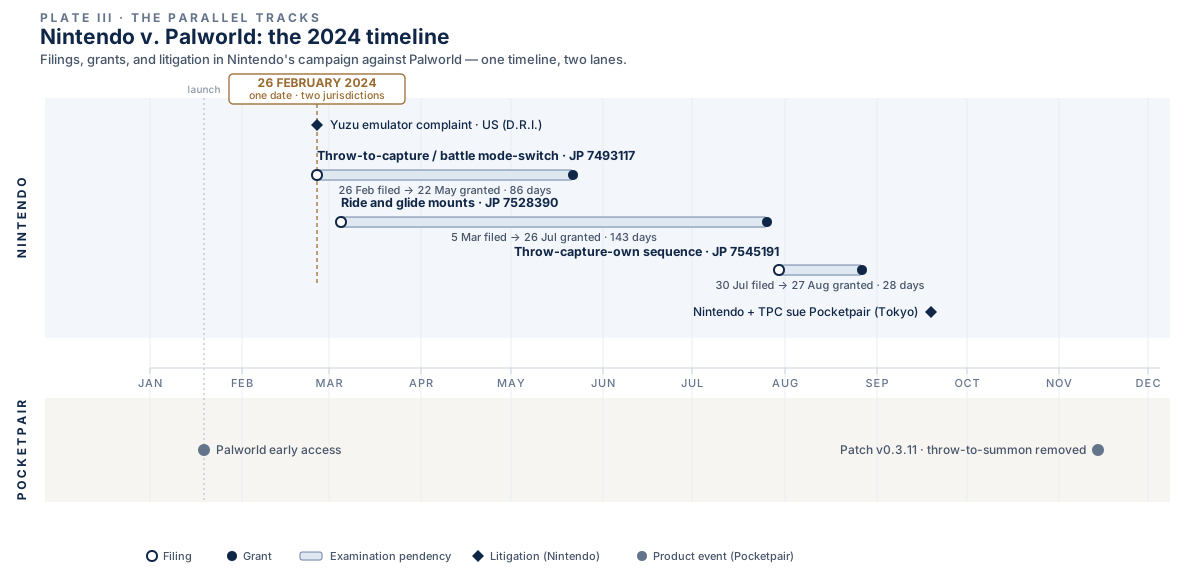
Then came the filings, and the dates deserve to be read slowly. On 26 February 2024, Nintendo filed the Japanese patent application that would become JP 7493117 — a patent on a mode-switching mechanic in which the player aims and throws an item at a creature in the field, with an on-screen indicator of capture probability, in one mode, and throws a combat character to initiate a battle in another. It was granted on 22 May 2024, eighty-six days later. On 5 March 2024, Nintendo filed what became JP 7528390 — mounting rideable characters and directing their movement, including through the air. Granted 26 July. On 30 July 2024, it filed what became JP 7545191 — the full throw-capture-own sequence, with the creature's status changing to player-owned on a successful hit and the probability indicator rendered in colours, graphics, or numbers. Granted 27 August, four weeks after filing.
Anyone whose experience of patents comes from the pharmaceutical or semiconductor worlds will recognise that these grant speeds are not normal, and anyone who checks the dates against Palworld's launch will notice that all three applications post-date the game they would later be asserted against. Both facts have innocent-sounding technical explanations, and the technical explanations are the interesting part.
The three patents are divisionals — child applications carved out of parent applications Nintendo had filed around 2021, in the era of Pokémon Legends: Arceus, the franchise's own experiment with open-world catching mechanics. Divisional practice works like this: a pending patent application functions as a reservation of territory. So long as the parent remains pending, the applicant may carve new child applications from it, each drafting fresh claims, and each inheriting the parent's original filing date for priority purposes — provided the new claims are supported by what the parent originally described. The system exists for legitimate reasons; patent offices force applicants to split applications that claim more than one invention, and divisionals are the mechanism. But the strategic use is an open secret of the profession: keep a parent application pending as a watching brief, observe what the market builds, and then draft claims shaped to what you have observed, backdated to a filing years before your target existed. The claims are new. The priority date is old. The target, by definition, came in between.
In the vocabulary of this piece: a licence to fortify, issued years earlier, held unexercised in a drawer — until a neighbour builds a prosperous mill, at which point the walls go up around it with the old licence nailed to the gate. Nintendo then compressed the timeline further through accelerated examination at the Japan Patent Office, which is how an application filed in July gets granted in August. All of it lawful. All of it standard practice, available to any applicant with the money and the foresight. That is rather the point: the adulterine castle was rarely illegal at the moment of construction either. It was a legal instrument deployed at a speed and with a purpose the surrounding legal order had not anticipated and could not immediately answer.
One more date, offered with the caution it requires. 26 February 2024 — the day the first divisional was filed — was also the day Nintendo filed the Yuzu complaint the previous section described. Almost certainly coincidence; legal teams do not typically choreograph filings across continents for dramatic effect. But it is a legible coincidence. On a single winter day, Nintendo moved to extend both of its fortifications at once — the hardware jurisdiction in an American courtroom, the interaction-model jurisdiction at the Japanese patent office. Whatever the diary logistics, February 2024 was the month the castellan decided the perimeter needed walls in two new places.
In September 2024, Nintendo and The Pokémon Company jointly sued Pocketpair in the Tokyo District Court, asserting all three patents. Note what the suit did not allege. Not copyright infringement — no claim that Palworld's creatures copied Pokémon's protected designs, the accusation the internet had spent months making on Nintendo's behalf. Not trademark. The suit claimed ownership of sequences of interaction: aim, throw, judge the hit, display the odds, transfer ownership, mount, glide. Verbs, not expressions. And verbs, it should be said, that Nintendo did not coin — the aim-throw-judge-claim sequence is the shared grammar of a genre other studios were working decades before these filings, a point the prior art would later make with some cruelty. What was being fenced was a commons. It was nonetheless the purest assertion yet of the proposition this piece has been circling: that what Nintendo defends most fiercely is the experiential territory itself, the way playing feels. Readers of this publication's mobile survey will recognise the shape. Apple ($AAPL) and Alphabet ($GOOGL) hold that kind of power — jurisdiction over what an experience may do rather than what it may look like — by owning the substrate everything else must run on. Nintendo owns no substrate beyond its own hardware, and so it is attempting to manufacture the equivalent in the patent register: capability control converted into formal title, because it cannot be asserted through ownership. Hold the thought; it matures later in the piece.
And then there is the money, which is where the case stops resembling ordinary commercial litigation and starts resembling architecture. Nintendo and TPC sought five million yen each — call it thirty-odd thousand dollars apiece — plus an injunction. The sum was a matter of arithmetic. A patent cannot be infringed before it exists, and these patents were granted in mid-2024 against a game released in January of that year, so the compensable window ran only from each grant to the September filing. A few months of exposure. The structure of the claim guaranteed from the outset that the damages would be trivial — which tells you, as clearly as anything in the record, that damages were never the objective.
What happened next is the centre of this piece. In November 2024, Pocketpair released patch v0.3.11, removing the ability to summon Pals by throwing spheres; creatures now appear statically beside the player. A later patch, v0.5.5, rebuilt gliding around a dedicated glider item rather than the Pals themselves. The company's accompanying statement is worth quoting in full, because defendants in active litigation are almost never this candid: "We continue to dispute these claims and assert the invalidity of the patents in question. However, we had to make certain compromises in order to avoid disruptions to the development and distribution of Palworld." Tribute, paid under protest, by a village that could not afford a siege whatever the eventual verdict on the lord's title.
The legal consequence of the patches is that the case has narrowed to older versions of the game. Patent analyst Florian Mueller, whose gamesfray and ipfray outlets have tracked the litigation more closely than anyone, assesses that Nintendo now has essentially no prospect of meaningful relief against current builds — no injunction with commercial bite, and a recovery he describes, not unfairly, as chump change. Treat that as informed analysis rather than settled fact; the Tokyo court has not ruled. But no serious observer disputes the shape of it.
So read the Palworld action as law, and it is a failure in progress: trivial damages, a narrowed case, an injunction unlikely to touch the product as it now exists. Read it as signal, and it is a complete success. A commercially ascendant competitor redesigned its shipped product — removed the mechanic closest to the heart of the genre overlap — without a single judicial finding against it. The claim did not need to be valid to be effective. This is what the motte-and-bailey was actually for. Castles were built to make sieges unnecessary — to settle the district's disputes in advance by standing there. The fortification worked precisely as eleventh-century doctrine said it would; the paperwork is merely still pending.
But this story, unlike most of the enforcement record that precedes it, has a second act, because this time the crown noticed.
Nintendo had been mirroring the Japanese family in the United States, using the USPTO's Track One programme, a fee-based priority lane that targets grant within about twelve months. One product of that effort was US 12,403,397 — summoning a sub-character to fight an enemy, with the battle running in player-controlled or automatic mode depending on the enemy's position — granted in September 2025. On 3 November 2025, the Director of the USPTO, John Squires, personally ordered an ex parte reexamination of that patent.
The machinery matters here. A reexamination is the patent office reopening its own decision: an issued patent is put back under examination against prior art, and its claims can be confirmed, amended, or cancelled. Anyone may request one. What almost never happens is the Director ordering one on the Office's own initiative — the sovereign, unprompted, questioning its own grant. By ipfray's count this was the first director-initiated order since 2012; across the entire history of the procedure, roughly one per cent of reexaminations have begun this way. When it happens, it is the institution signalling that something got through the gates that should not have.
Then came the prior art, and with it the record's one moment of genuine comedy. The Director's order rested on two references teaching precisely the claimed manual-and-automatic battle modes: a Konami application published in 2002, from a Japanese filing made in 2001 — two decades before the "invention" — and Nintendo's own application US 2020/0254335, filed in 2019. When the examiner issued the first office action, every claim under reexamination was rejected as obvious, with Nintendo's own 2019 filing as the primary reference, reinforced by Konami, another Nintendo publication, and a Bandai Namco reference on the dependent claims. The castellan's new fortification, declared redundant by the crown's surveyor, on the grounds that the castellan had already built on this exact ground six years earlier — and that the neighbouring lords had built there twenty years before that. Nor is 12,403,397 an isolated casualty: across the wider US family, examiners have been rejecting claims in bulk on the same obviousness grounds.
Here, then, is the Conquest sequence run at modern speed. William fortified England between 1066 and 1070 and commissioned the survey that ratified the holdings in 1086 — practical control first, legal record afterwards, the record largely confirming what the castles had already decided. Nintendo fortified in the spring of 2024 and sought its title in the same motion, divisionals backdated, examination accelerated, the suit filed within weeks of the final grant. The difference is that this crown arrived with the survey open and has begun recording that some of these works were raised without adequate licence — the slighting already in progress, claims cancelled, families rejected, the Office's own Director leading the demolition.
And yet note what the slighting will not restore. The throwing mechanic is gone from the game; the gliding was rebuilt; the design territory was ceded while the title was still in dispute, and no reexamination certificate will un-cede it. Adulterine castles can be torn down; the behaviour they compelled while standing does not get rebuilt. That asymmetry — between how easily the law can void a claim and how completely the claim reshaped the world before being voided — is the single most important fact this survey has to record. It is also, for anyone attempting to price Nintendo's enforcement strategy as an asset or a liability, the entire question.
VI. The Home Duchy
William was two different rulers, and the reason was territorial. In England he was the castellan-king of a conquered province: castles in every county, land held by right of seizure, an imported aristocracy governing through fortification. In Normandy, the same man in the same years ruled in an entirely different register — as a duke among institutions that predated him and would outlast him, bound by the customs of the province, the rights of his peers, the courts of the Church, the slow accumulated law of a settled society. At home he litigated, negotiated, endowed abbeys, and kept the peace of a land where his power was one thread in a fabric of mutual obligation. The castles were for England. And that contrast is the sharpest analytical instrument this survey possesses, because Nintendo, too, has a home province — and given everything recorded in the preceding sections, the commissioners ride into it expecting the fiercest walls of all around the home treasury. What they find is the most important surprise in the piece.
Twice a year, in Tokyo, the fan-works fair called Comiket fills one of the largest exhibition complexes on earth. Tens of thousands of self-publishing circles — the historic norm runs to roughly thirty-five thousand per edition — sell printed works to crowds that have at peak editions approached three-quarters of a million people over a few days; the organisers' archive of sample copies runs past two million items. And the overwhelming majority of what is sold there is derivative: fan works built on characters and worlds owned by the very publishers whose headquarters stand a few train stops away — including, abundantly, openly, and for money, the most valuable media franchise in history, which is Pokémon. Read that paragraph with the eyes of a Western IP department and it describes the largest concentrated copyright-infringement event in the world, held on a published schedule, at a fixed address, twice a year, for four decades. Read it with Japanese eyes and it describes a cultural institution — one the rights-holding industry itself has repeatedly moved to protect.
The machinery that makes this possible deserves to be explained from first principles, because it is a genuinely different constitutional choice, not a loophole. Japanese copyright infringement has historically been shinkokuzai — a complaint-based offence. The state does not prosecute unless the rightsholder formally asks it to; no complaint, no crime, however open the conduct. Consider what that structure does. It writes rightsholder discretion into the operating system of the law itself: tolerance becomes a standing legal condition, revocable by the lord at any time and therefore, crucially, his to grant. The doujinshi economy lives in that granted space, and everyone involved knows it — the circles, the publishers, the event organisers. It is a gentleman's agreement in the most literal sense: an arrangement whose entire force is that the party with the power to end it, visibly and continuously, chooses not to.
And when the arrangement was threatened, the industry defended it. Japan's accession to the Trans-Pacific Partnership obliged it to make copyright infringement prosecutable without complaint — a change that, drawn broadly, would have handed enforcement to prosecutors and police and ended the discretion on which the whole settlement rests. The 2018 amendments that resulted are a study in deliberate narrowness: the non-complaint category was confined, after concerted lobbying in which the content industry itself was prominent, to essentially verbatim copies sold in the market's place — piracy in the ordinary sense — precisely so that derivative fan works would remain within the complaint-based regime. The public debate around the carve-out said the quiet part aloud: the fan-creation economy was a nursery of talent and demand that the industry did not wish to see policed out of existence. Tolerance, in Japan, is negotiated policy — a treaty between lords and commons, renewed in legislation, with Nintendo's own industry among its signatories.
So how does Nintendo behave inside the treaty? Like a lord among peers, is the answer — which is to say, conventionally, proportionately, and through the ordinary courts. The instructive case is MariCar. From the mid-2010s a Tokyo company rented go-karts to tourists, dressed them in Mario costumes, traded under a name universally read as shorthand for Mario Kart, and sent the resulting spectacle through the streets of the capital in open free-riding on Nintendo's marks. Nintendo sued — in 2017, in the Tokyo District Court, on unfair-competition grounds — and won a judgment of roughly ten million yen, raised to fifty million by the Intellectual Property High Court on appeal. Note everything about the shape of that action. The claim was consumer confusion and commercial free-riding — conventional grounds any trademark owner anywhere would recognise. The forum was the ordinary domestic system, both instances, on the merits. The remedy was proportionate to a real commercial harm. Nothing in it resembles the timber-motte takedowns of the conquered lands or the manufactured title of the patent campaign; it is what the defence of a genuine bailey looks like when the defender operates inside a settlement.
The exception in the domestic record proves the same rule. In 1999, a doujin artist was arrested and fined over sexually explicit Pokémon parody works sold by mail order — one of the first criminal actions against a doujin creator, and it required exactly what the treaty requires: a formal complaint from the rightsholders. Their stated reasons were brand harm and the material's accessibility and commercial distribution — the work had left the fair-stall scale of the settlement and threatened the franchise's meaning to children. What triggered enforcement at home, in other words, was conduct that had left the treaty's terms, not derivation itself. Derivation is the water Comiket swims in, and Pokémon doujinshi returned to its stalls the next season and has been sold there ever since. At home, the line is legible, negotiated, and stable; the commons knows where it is because the commons helped draw it.
The peers confirm the pattern. Capcom publishes fan-content guidelines that expressly tolerate small-quantity hobbyist doujin sales; Square Enix's written policy is stricter on paper and case-by-case in practice; The Pokémon Company itself issued fan-content guidelines in 2023 blessing non-commercial fan creation; Nintendo's own network guidelines, quoted earlier in this piece, extend the same conditional welcome. And consider the dog that has never barked: Capcom's Monster Hunter has operated for two decades in creature-adjacent design territory — hunting, taming, collecting monsters in an open world — a few districts from Pokémon's home castle, without a writ, a filing, or a cross word entering the public record. Between lords inside the settlement, adjacency is simply neighbourhood. The perimeter that abroad is patrolled with divisionals and takedowns is, at home, a boundary agreed among peers.
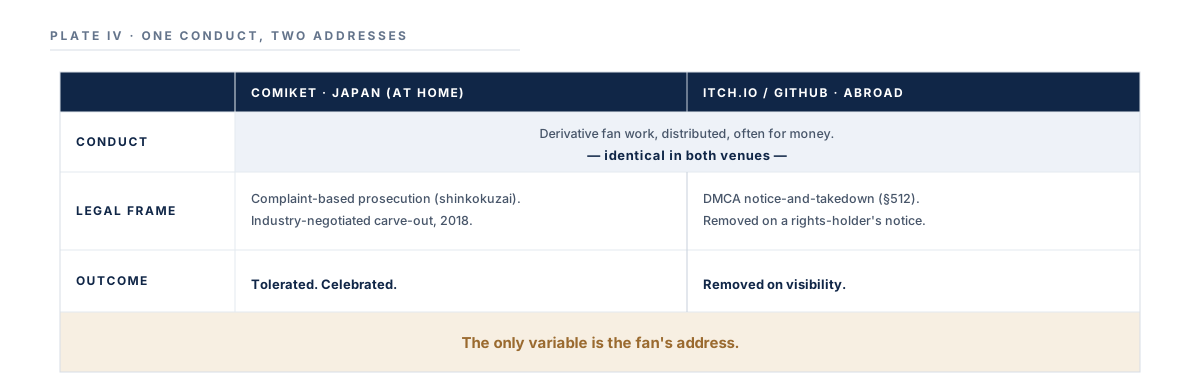
Now collect the question the survey deferred here from the conquered lands. The 2016 fan games fell, this piece argued, in ground Nintendo had left fallow — and the question deferred was whether the enforcement that felled them protects creative work or the commercial conditions around it. The home province answers it, because the home province holds the controlled experiment. The category of conduct is identical: derivative fan works, built on Nintendo's characters, distributed to the public, often for money. At Comiket the conduct is tolerated, carved out of the criminal law by the industry's own lobbying, and culturally celebrated. On itch.io or a GitHub page, the same conduct is noticed, and noticed means removed. The conduct is identical in both places; the only variable is the fan's address. And a protection that varies by address can only be defending the conditions. The work is identically "violated" in both places, so the work itself cannot be the thing protected: what the moat defends is the settlement at home, where the commons feeds the industry's talent and demand on negotiated terms, and the scarcity abroad, where an unlicensed commons fills gaps the company has chosen to leave open, on terms the company has not set. The moat, this section is obliged to record, is drawn around the absence of a treaty. Around Pokémon itself, where a treaty holds, there is no moat at all.
One power, two postures, and the choice of posture tracks the presence of a settlement — which is the finding that re-reads everything before it. The lord of the home duchy demonstrably knows how to live under a gentleman's agreement: to litigate proportionately, to tolerate a thriving derivative commons, to let peers work adjacent ground in peace, and to defend the arrangement in the legislature when it is threatened. The Harrying abroad is therefore a chosen posture, adopted for territories where nothing obliges the lord to rule otherwise — and the home duchy proves he knows more than one way to rule. And a chosen posture, unlike a temperament, invites comparison — because other lords, holding other lands under the same absence of obligation, have chosen differently. The survey has finished with Nintendo's own territories. It rides now to the borders.
VII. The Neighbouring Realms
Every analysis that leans on a single figure has eventually to test it against the cases it did not choose. Nintendo has been read here through one extended metaphor; the comparison that follows deliberately sets it down. The three companies that share Nintendo's structural problem — a commercially owned creative world surrounded by a commons of players and builders whose activity both creates the world's value and escapes its owner's control — are clearer in plain terms, and the contrast in how they answer it is where the argument stops being about Nintendo and becomes about a choice.
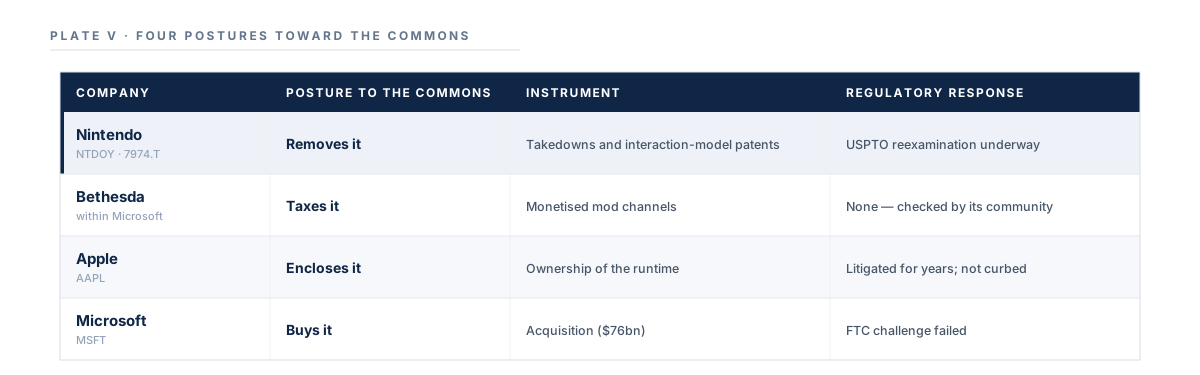
Four companies, four answers. Nintendo removes the commons. Bethesda taxes it. Apple encloses it. Microsoft ($MSFT), arriving late to a landscape where the valuable creative worlds were already built, tried to buy one outright. The remaining three are worth taking in turn, because it is the comparison that converts Nintendo's record from a corporate profile into evidence about a decision.
Apple: winning the case, keeping the toll
Apple's territory this publication has already mapped, and the fact most coverage inverts is the place to start: Apple won Epic v. Apple. Of the ten counts tried in 2021 it prevailed on nine, including every federal antitrust claim; the court declined to find monopoly power in the relevant market; the Ninth Circuit affirmed in 2023 and the Supreme Court denied certiorari in January 2024. The most consequential legal challenge ever brought against the App Store model left the model intact. Epic won a single count — a finding under California's unfair-competition law that Apple's anti-steering rules, which barred developers from even telling users cheaper options existed outside the app, unlawfully withheld information — and the remedy was correspondingly narrow: developers must be allowed to link out.
What Apple did next is the most instructive conduct in the comparative record. It complied in form, permitting external links, and attached to them a 27% commission on anything bought through one, with design constraints on how the links could appear. A 30% charge at the front door; a 27% charge at the side door the court had ordered opened. The economics of steering survived almost intact, which was the point. In April 2025 the district court found Apple in civil contempt — a wilful violation of the injunction, in its words — and the ruling's sharpest passage concerns the testimony, not the fee: the court found that a senior Apple finance executive had "outright lied under oath" about when the fee scheme was devised, that the company adopted the falsehood rather than correct it, and referred the matter to federal prosecutors for possible criminal contempt. The Ninth Circuit affirmed in December 2025. The sequence bears stating flatly: ordered to open one door, the company installed a toll booth in the doorway, and when questioned lied about when it was built.
Europe produced the same posture in regulatory form. The Digital Markets Act prohibited anti-steering by designated gatekeepers outright; Apple's compliance package answered with a Core Technology Fee of €0.50 per first annual install, levied on developers above a one-million-install, €10-million-revenue threshold and — the detail this readership will check against the mobile survey — payable across every distribution channel, Apple's own App Store included. It is a charge for being installed on an iPhone, owed whether or not the user ever opens the app and independent of any transaction. The European Commission fined Apple €500 million in April 2025 for breaching the anti-steering obligation, finding the fee-and-friction architecture suppressed the very alternatives the statute existed to create. Regulators write the obligation; Apple's engineers rebuild its economic function one layer down.
Here the observation seeded in the patent section resolves. Apple has never needed to patent an interaction. It decides what every app on a billion devices may do — what may be sold, through which channel, at what rate — because it owns the operating system those apps run on, and ownership makes the rule self-executing: no filing, no lawsuit, no examiner. This publication's survey of the mobile duopoly traced that power in full; the point here is comparative. Nintendo owns no such substrate beyond its own console, and so it has tried to manufacture the same control through the patent register — capability converted into formal title because it cannot be exercised through ownership. And the comparison exposes what manufacture costs. Apple's control survived a federal trial, an appeal, and a continental statute because it is infrastructure before it is law. Nintendo's engineered equivalent began unravelling the moment a patent examiner read it closely. The most durable version of this power is the one that never has to be asserted as a claim, because it is already present as a fact.
Microsoft: buying the portfolio, missing the point
Microsoft's answer to the same problem was capital. Lacking Nintendo's half-century of organically accumulated attachment, it bought: ZeniMax — Bethesda's parent, holding The Elder Scrolls, Fallout and Doom — for $7.5 billion in 2020, and Activision Blizzard, with Call of Duty and Warcraft, in a deal that closed in October 2023, together roughly $76 billion of content acquisition and the largest such spend in the industry's history. The strategic theory was stated plainly for regulators and more candidly in discovery: exhibits from the FTC's attempt to block the Activision deal included an internal exchange relaying that all future ZeniMax titles would be Microsoft-exclusive, notwithstanding the softer language offered publicly at acquisition. Content was the fill: owned franchises were meant to make Game Pass, the subscription service, the destination that hardware alone had never made Xbox.
This publication has traced the megadeal era in full, and its verdict bears directly on Nintendo: Microsoft was buying density for a subscription catalogue, not attachment, and the two are not the same asset. The post-acquisition record makes the distinction concrete. In January 2024, three months after the Activision close, Microsoft cut roughly 1,900 gaming roles. In May 2024 it closed studios outright, among them Tango Gameworks, whose Hi-Fi Rush had launched the previous year to precisely the critical warmth the acquisitions were meant to secure. The detail that finishes the argument came within months: Krafton, the South Korean publisher, acquired Tango and revived it. The studio Microsoft judged surplus to a $76-billion content strategy was worth saving to a rival — the buyer of the portfolio could not see the value; an outsider could.
The subscription engine those franchises were bought to feed is now visibly under strain, and the strain is the one Nintendo's story turns on. Game Pass was raised to $29.99 a month in October 2025, specifically to absorb the cost of putting Call of Duty on the service day-one; subscriber growth had already plateaued in the mid-thirty-millions, below Microsoft's own internal projections. Including the franchise at launch appears to have converted premium sales into subscription access — Bloomberg put the cost to Black Ops 6 at around $300 million in forgone sales, and Black Ops 7 fell roughly 60% year on year per a court filing by Activision's former CEO, with Battlefield 6 displacing Call of Duty as the best-selling US title of 2025 — while the price rise it necessitated created an affordability problem the company then had to reverse. In April 2026 the new Xbox leadership cut Game Pass Ultimate back to $22.99 and ended day-one Call of Duty, undoing two years of price increases and, with them, the exclusivity-and-subscription thesis the acquisitions were built to serve. The strategic misalignment behind that reversal is its own subject; what matters here is the outcome. Microsoft assembled the largest content portfolio in the industry and remains its third-largest company by gaming revenue. Exclusivity has quietly given way to shipping former flagships on PlayStation, rebranded as reach, and console-unit disclosure has stopped altogether — a silence that is itself a disclosure.
The finding writes itself, and it is the comparative lesson Nintendo's record most needs beside it. Microsoft acquired the industry's deepest portfolio of owned franchises and discovered that the thing a creative world is valuable for — the attachment, the loyalty, the felt relationship between the world and the people who live in it — did not transfer at closing. Attachment is grown, not bought. Which sets Nintendo's conduct in its actual light: the asset Nintendo defends is real, organically accumulated, and genuinely inimitable, the one thing $76 billion demonstrably could not purchase, and the standing question of this piece is why a company holding the only asset of that kind treats the communities that produce it as an adversary.
Bethesda: taxing the commons it depends on
Bethesda — now itself inside Microsoft's portfolio — holds the posture closest to a genuine accommodation with the commons, which is what makes its lapses diagnostic. No major publisher has built its commercial model more openly on player creativity. It ships official modding tools with its flagship titles; its executives spent a decade evangelising the practice — Todd Howard's line, at the 2012 DICE summit, that great games "are played, not made" belongs to this register — and the dependence is measurable. Skyrim, sustained overwhelmingly by its modding community across re-release after re-release of a 2011 game, had sold more than 60 million copies by Howard's own mid-2023 accounting, while Bethesda titles sit permanently near the top of mod-platform download tables whose totals run into the billions. The modding commons is the business's second engine.
Three times Bethesda has tried to meter it. In April 2015, with Valve, it launched paid Skyrim mods on Steam, splitting revenue 25% to the creator against 45% to Bethesda and 30% to Valve; the scheme collapsed within a week under community revolt. In 2017 it returned as Creation Club, curated paid content whose own FAQ opened by asking "Is Creation Club paid mods?" and answering "No" — a denial the market read as confirmation. In late 2023 it came back as Creations. Three attempts, one pattern: the unpaid labour of the commons repackaged as a revenue line, each time framed as creator empowerment, each time reserving the larger share for the platform.
And then the episode that shows both what the commons can build and what an owner's indifference can cost it. Fallout London — a total conversion of Fallout 4 on the scale of a commercial expansion, four years of unpaid work by a team of dozens — was finished and dated for 23 April 2024. Two days later Bethesda shipped a "next-gen update" to Fallout 4, timed to the Amazon television series, that broke mod compatibility across the board; the team, whose project Bethesda had publicly acknowledged, learned of the collision when the public did, and the release slipped to July on GOG. The reception completed the inversion: Fallout London arrived to admiration for its scale and finish while the official update was widely judged to have broken more than it fixed. This is the comparison Nintendo's enforcement speed never permits to occur. AM2R was removed before anyone could measure it against the official remake that followed; Fallout London survived long enough to be measured, and the fan work won. Bethesda's posture — depend on the commons, tolerate it, periodically tax it, occasionally break it by accident — is no one's idea of a coherent code. But the commons it half-honours is alive, productive, and demonstrably capable of work at the official standard. A creative base that is merely taxed still produces. One that is removed on sight does not.
Three regulators, three outcomes
One comparative observation remains, and it is the one that carries into the accounting. This piece has leaned throughout on a frame in which aggressive claim-making eventually invites a central authority to check it. The frame implied one such authority; the record delivers three, behaving three different ways. The USPTO is actively unwinding Nintendo's interaction-model patents, a director-ordered reexamination in hand. The US courts and the European Commission have pursued Apple for half a decade — injunction, contempt finding, criminal referral, statute, €500-million fine — without disturbing the economic function of its control. And the FTC tried to stop Microsoft's Activision purchase outright, and lost. Three regulators, three postures, three outcomes, across the same handful of years.
The pattern is the analytically important part. Authority in this sector is real, but slow, inconsistent, and split across jurisdictions that neither coordinate nor reliably reach the layer where control actually sits — the patent register in one case, the operating system in another, the balance sheet in a third. That is precisely the environment in which building the claim first and defending the title later pays: the response, when it comes, arrives late, lands unevenly, and rarely reaches the thing it was aimed at. Nintendo has read that environment correctly. What its reading has cost the ground it holds is the last entry the survey owes.
VIII. Domesday — The Survey Returned
The commissioners are home; the book is open; the three questions it was commissioned to answer have not changed. What is held. By what right. And what, in the taking, was laid waste.
What is held, first, and let the entry be made without irony. The walls hold. The hardware jurisdiction raised in the emergency of 1983 stands after forty years and six generations — the longest-running and most successful platform-control regime in the sector's history, tested in court in its first decade and never seriously breached since, its one great sacking answered so thoroughly that the countryside remains quiet years later. And within the walls stands the thing they were nominally built for: a bailey that is entirely genuine. Half a century of creative output has produced the deepest reserve of cultural attachment in the industry — the asset the neighbouring realms' record proved cannot be bought at any price, only grown. Nintendo holds the walls, and Nintendo holds the one thing in this landscape that is truly scarce. Both entries are accurate. The tension of this entire survey is that the second did not require the first.
By what right, second — and here the book must record two answers, because the lord gives two. In the home duchy the right is a settlement: negotiated, legislated, honoured on both sides, under which the lord litigates like a lord, tolerates a thriving derivative commons, and lets his peers work adjacent ground in peace. No entry in this survey reflects better on the house, and none is more damning of the conduct abroad, because it proves the alternative was always available and always understood. Abroad, the right is the fortification itself — takedowns that no judge reviews, a trafficking theory that no trial tested, and a title manufactured after the fact whose slighting by the crown is now under way even as the behaviour it compelled stays compelled. The survey records the asymmetry it found at the heart of the patent campaign and finds it general: across the whole conquered territory, the claims are eroding and their effects are not. That is exactly what claim-making in weak-authority landscapes is for, and the record shows the lord knows it.
What was laid waste, third — and the entries are specific, because a survey's entries always are. A nine-year fan work, withdrawn in the week of its triumph. A remake the community judged finer than the official one that followed it, removed on its franchise's anniversary. An emulator destroyed with a theory never tested, and a second project — uninvolved, emulating a discontinued machine — pulled down in the same capitulation; a third, ended by a phone call. A commercial studio that redesigned a shipped product while still disputing the claims against it. And, harder to enter but present on every page, the submissions that no notice ever had to compel: the projects not started, the boundaries internalised, the map every village now carries. Set these entries beside the code this survey recorded near its beginning — the seal that promised excellence, the president who would not trade his people for a quarter, the designer who insisted his works were toys to be explored — and the question the chanson left open returns for its answer: whether the lord's obligations run in both directions. The record's answer is an entry, not a sentence: upward, the obligations of the commons have been enforced with perfect consistency; downward, they have been honoured where a treaty compels it and harried where none does. The demesne that is merely taxed, the neighbouring realm showed, still grows things. Entry by entry, this book records what the other posture grows.
One disanalogy remains, and it is kept deliberately, because it is where the survey's findings become a forecast. The Harrying worked for William for a reason that has no modern equivalent: his subjects were bound to the land. The peasantry of a creative commons is not. It migrates — to other worlds, other lords, other baileys that want what it grows — and it migrates silently, because attachment does not file a notice of departure. The costs entered in this book are therefore real but deferred, and they are denominated in the only currency the bailey runs on: the attachment that cannot be bought, only grown — and, the corollary the record now supports, only eroded, never seized back. A moat can hold ground. It has never once, in this survey or in the eleventh century, held affection.
Domesday was so named, the English said, because there was no appeal from it. This survey claims no such authority. It enters no verdict, recommends no sentence, and concedes that the walls it has audited may stand another forty years; fortifications usually do. It records only what it was commissioned to record: a genuine bailey, held behind a widening moat, by a lord with two postures and one code; a crown that has begun, unevenly, to slight the newest works; and a countryside of entries that the lord's own book does not keep. That is the survey's last observation, and it is offered to the reader who came here to price the strategy. There are two ledgers now being written about Nintendo. One is this kind — courts, patents, filings, the paperwork of the moat — and Nintendo is winning in it more often than not. The other is kept in the villages, in the currency the whole estate actually runs on, and it has no fixed survey date, no commissioners, and no appeal either.
