
Playgrounds
Imagine a town with one playground. Children may enter freely; the gate has no charge. The equipment — every swing, every climbing frame, every patch of ground on which a game might be played — is owned by the firm that built the playground. Other firms are permitted to bring games into the playground, and children are permitted to play them, but the firm that owns the equipment collects a fee on every game played, including games it neither invented nor maintains. Other playgrounds exist in principle. None has the equipment, the children, or the permission to operate at the same scale. The town has, in practice, one playground.
This is the iPhone. The playground is iOS. The equipment is the operating system itself — the application programming interfaces, the payment infrastructure, the device capabilities, the runtime environment that determines what software can do and how it does it. The games are the apps. The fee is the App Store commission, the Core Technology Fee, the 27% on linked-out transactions in the United States, the 26% in South Korea, the 17% plus 3% plus €0.50 per install in the European Union: a series of charges, structured differently in different jurisdictions, all flowing from the same underlying asset. The asset is not the storefront. The asset is the playground.
The distinction matters because it is what most coverage of mobile platform economics gets wrong. The dominant frame, in trade press and regulatory commentary alike, treats Apple ($AAPL) and Google ($GOOGL) as operators of dominant digital storefronts whose 30% commission is the headline grievance and the natural object of reform. This frame produces the regulatory architecture of the past five years: laws and rulings that mandate alternative app stores, alternative payment systems, the right to steer customers to the open web. These are interventions at the playground gate. They have not, on any available evidence, reduced the platform rent in economically material ways. Apple's services gross margin reached 75.4% in fiscal 2025, expanding 460 basis points across three years through the most aggressive global regulatory cycle the platform has faced. Match Group ($MTCH), in its most recent annual report, tells its shareholders not to expect meaningful relief on platform fees from any of the regulatory interventions currently in motion. The rent is durable because the rent is not at the gate. The rent is on the equipment.
The clearest available evidence of this is a fee Apple has been required to disclose only because European regulators forced it into the open. Under the Digital Markets Act, which entered into force across the European Union in March 2024, Apple was obliged to permit alternative app stores, sideloading, and alternative browser engines on iOS. Apple's response, contained in its DMA compliance package, restructured the fee architecture rather than dismantling it. The headline App Store commission fell from 30% to 17% in the EU; a separate 3% payment processing fee brought the transaction cost to 20%; and Apple introduced a Core Technology Fee — €0.50 per first annual install above one million downloads, payable for any developer with global revenue above €10 million, applicable across the App Store, alternative app stores, and direct distribution alike. The Core Technology Fee is not a transaction fee. It applies whether the app monetises the user or not. It applies whether the user opens the app after installing it or not. It is, in posted commercial terms, a charge for being installed on iPhones. For a free app with ten million annual downloads at the threshold, the obligation is €4.5 million annually, payable to Apple, regardless of revenue. The CTF is what runtime pricing looks like when distribution is opened by force and the equipment owner is required to put a number on the asset that remains.
This piece argues that the structural durability of mobile platform rent is the central feature of the sector's economics, and that buy-side analysis predicated on the regulatory cycle producing material change is mistaken. The argument rests on a distinction between the two layers of platform control and a recognition that runtime control monetises through three identifiable mechanisms. Distribution control is the power to decide what software a user can find, download, and install. It operates at the level of the storefront. Runtime control is the power to decide what software can execute on a device, what application programming interfaces it can access, what business models it can technically implement, what default behaviours the operating system enforces. It operates at the level of the equipment. The mobile duopoly possesses both. The PC platform holders possess only the first, and even that weakly.
Within runtime control, three rent types are visible in the documented record. Fee Rent is the App Store and Play Store commissions — the conventional charge applied to transactions within the platform's distribution channel. Access Rent is the Core Technology Fee and its equivalents — the platforms' explicit pricing of runtime access when distribution is opened by regulatory force. Capability Rent is the rent extracted through capability allocation, default settings, application programming interface access, and platform-controlled advertising surfaces — the mechanism that does not appear as a transactional fee but that produces measurable economic effects nonetheless. Every contested element of mobile platform economics over the past five years can be located within this taxonomy. Each of the three rents has been engaged by regulators. None has been materially constrained.
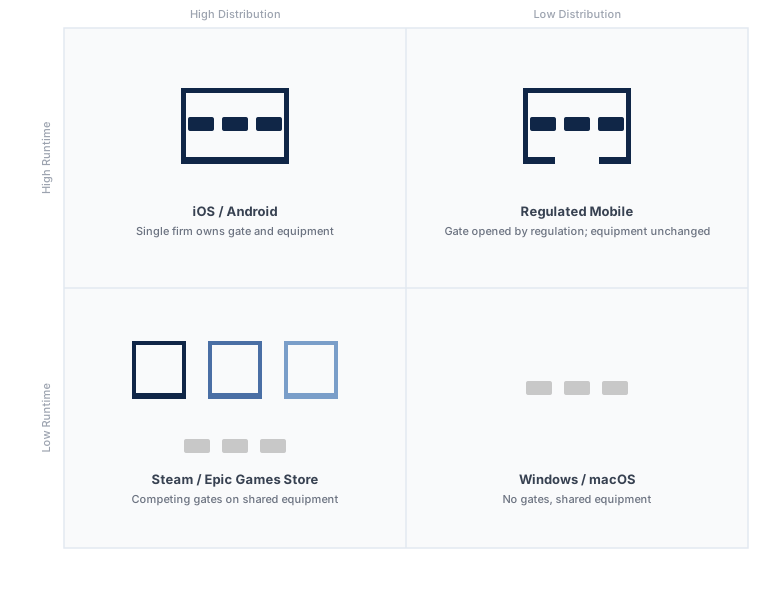
The remainder of this piece develops the case in four movements. The first establishes the rate and the rent: the origin of the 30%, the services margin disclosures that quantify the platform's position, the console comparison, and the App Tracking Transparency episode as the cleanest demonstration of runtime power. The second documents the foreclosure through four coordinated case studies — Fortnite, Match v. Google, the South Korean Telecommunications Business Act amendment, and the Dutch Authority for Consumers and Markets ruling on dating apps — each of which targeted the rules and none of which reached the equipment. The third tracks the convergent regulatory response across seven jurisdictions and the convergent compliance fee structures Apple has deployed in answer. The fourth draws the buy-side inference.
The Core Technology Fee remains the sharpest piece of evidence the piece will assemble. Apple has, in its own posted commercial terms, priced the equipment. Everything else in this piece is the case for taking that price seriously.
The Three Rents
The console industry has its own playgrounds, and they have charged 30% on games played in them for forty years. Before any of the contemporary regulatory record existed, the basic shape of platform economics was established by Nintendo's hardware lockout chip in the 1980s and inherited across PlayStation, Xbox, and eventually the App Store. The rate is industry convention. What distinguishes mobile is not the rate but how runtime control monetises around it. Three mechanisms are visible in the documented record. Each operates differently. Each has been engaged by regulators with different remedies. None has been materially constrained.
Fee Rent
Fee Rent is the most visible of the three and the only one most coverage of platform economics addresses. Apple adopted 30% in 2008 when the App Store launched; Google followed within months; the rate has been the standard ever since, with selective reductions for small developers and for second-year subscription revenue. Fee Rent has been the focus of antitrust litigation, ex ante regulation, and most public commentary on platform economics. It is also the rent type the piece will spend the least time on, because the structural argument turns on what surrounds it rather than on the rate itself.
What surrounds it is the economic context in which Fee Rent operates. Console platforms accept low or negative hardware margin precisely because the platform commission is what makes the install-base economics work. PlayStation and Xbox consoles have been sold at or near cost across multiple generations; even Nintendo's Switch hardware margin has been estimated at roughly 14%. Apple does not accept this trade. Across fiscal years 2023, 2024, and 2025, Apple's products segment reported gross margins of 36.5%, 37.2%, and 36.8% respectively — roughly three to four times higher than equivalent console hardware margins at any comparable point. Apple operates a consumer electronics business at consumer electronics margins, and on top of that hardware business operates a services business that charges console-style platform commissions.
The services segment is where Fee Rent's quantitative scale becomes visible. Apple discloses services as a separate segment with separate cost-of-sales and gross margin figures. In fiscal 2023, services net sales were $85.2B at a 70.8% gross margin. In fiscal 2024, $96.2B at 73.9%. In fiscal 2025, $109.2B at 75.4%. The segment grew 460 basis points of margin across three years through the most concentrated global regulatory cycle the platform has faced. Services represented 26.2% of Apple's total net sales by the most recent reported quarter, up from 22.2% in fiscal 2023; the blended corporate gross margin moved from 44.1% to 46.9% over the same period, driven not by hardware margin expansion but by services growing as a share of mix and continuing to expand its margin. The 75.4% services figure includes more than the App Store — iCloud, Apple Music, AppleCare, advertising, and licensing income including the Google search default agreement. Public estimates place App Store gross margin specifically in the 80%+ range. Apple disputes these estimates and has never disclosed App Store margin separately. The disclosed services figure is the conservative position. It is conservative enough.
The Fee Rent applies to an activity whose financial scale was not clear at the App Store's launch and which has grown faster than any single sector inside Apple. Free-to-play monetisation, originated by Nexon in South Korean PC online gaming in 1999 and matured for over a decade in Asian markets, transplanted to mobile with GungHo's Puzzle & Dragons on Japanese iOS in February 2012. Puzzle & Dragons became the first mobile game to gross $1 billion in revenue. Its 2013 financial year split — $650M through Apple's App Store and $775M through Google Play — established that single-game annual revenues would routinely exceed major console franchise releases. The platforms collected approximately 30%.
The mobile platform did not invent these monetisation mechanics. It made them commercially scalable. Five conditions, all attributable to runtime control, were necessary for the modern free-to-play model to function at the scale the financial figures indicate: frictionless micropayment through stored payment credentials at the operating system level; persistent connectivity enabling live-service game state and real-time experimentation; behavioural telemetry at platform scale, including cross-app identifiers; the always-in-pocket form factor enabling micro-session monetisation; and the absence of an upfront purchase moment, which inverted consumer expectations from premium pricing to free-default. Each condition was a feature of the iOS and Android runtime environments. None could have been provided by a digital storefront alone. Console publishers subsequently adopted the resulting mechanics — FIFA Ultimate Team, Star Wars Battlefront II's loot boxes, the seasonal battle pass model — once the financial scale of the mobile cases became impossible to ignore. Mobile was the originating environment. Console adoption followed.
Access Rent
The Core Technology Fee is the cleanest available example of Access Rent in operation. When the European Union's Digital Markets Act required Apple to permit alternative app stores, sideloading, and alternative browser engines on iOS, Apple's compliance package preserved the platform's economic position by introducing a charge that did not exist before: €0.50 per first annual install above one million downloads, payable for any developer with global revenue above €10 million, applicable across the App Store, alternative app stores, and direct distribution alike. The CTF is not a transaction fee. It applies whether the app monetises the user or not. It applies whether the user opens the app after installing it or not. It is a charge for being installed on iPhones, separated from the question of which storefront the user installed the app from or which payment system processed any subsequent transaction.
Access Rent is what runtime pricing looks like when the platforms are required to put a number on it. The Core Technology Fee is the most explicit version, but the same rent type appears across the regulatory cycle in different formats. The 27% commission Apple charges on linked-out transactions in the United States after the Epic injunction. The 26% commission in South Korea on alternative payment systems. The 27% commission in the Netherlands on dating-app transactions. The 15% steering commission with a 5% Core Technology Commission in Japan and Brazil. These are different jurisdictional expressions of the same underlying mechanism: the platforms charging for runtime access as a discrete item, distinguished from the commission on transactions occurring within the platform's own payment infrastructure. The fourth section catalogues the convergence in detail. The point for present purposes is that Access Rent did not exist as a named, posted commercial item before regulatory pressure forced platforms to articulate what they were charging for. The pressure produced the explicit pricing. The pricing is durable.
Capability Rent
Capability Rent is the least visible of the three and the most analytically important. It does not appear as a transactional fee; it appears as commercial value redistributed through unilateral changes to what is technically possible on the device.
The most probative evidence of Capability Rent's mechanism is App Tracking Transparency (ATT). On 26 April 2021, Apple released iOS 14.5, which introduced ATT. The name is misleading. ATT does not track users; it gates access to a pre-existing tracking identifier that Apple had embedded in every iPhone since 2012. Each device carried a unique Identifier for Advertisers (IDFA), readable by default by any app that requested it. When a user installed Facebook, the app read the IDFA. When the same user installed a mobile game, the game read the same IDFA. Advertising networks could connect behaviour across apps because every app on the device was reading the same operating-system-level identifier. The infrastructure on which the entire mobile advertising attribution and targeting system was built between 2012 and 2021 was not Meta's, not Snap's, not the advertising networks'. It was Apple's. The third parties were tenants on Apple's identifier.
ATT changed one thing. Apps that wanted to read the IDFA were now required to display a system-generated prompt asking the user for permission to "track your activity across other companies' apps and websites." When users declined, the IDFA became inaccessible to that app. The cross-app linking that had powered mobile advertising for nearly a decade went dark for any user who said no, and most users, indeed, said no. Apple wrote the prompt language. Apple chose the word "track." Apple structured the binary as "Allow" versus "Ask App Not to Track," framing the granting of permission as the active choice. Industry data showed initial US opt-in rates in the 15-35% range. The prompt was designed to maximise refusal. The refusal rate was the policy.
The financial consequences were precise and rapid. On Meta's ($META) Q4 2021 earnings call on 2 February 2022, CFO Dave Wehner told investors that the impact of Apple's iOS changes on Meta's 2022 revenue would be approximately $10B — roughly 8-9% of Meta's total revenue, attributable to a single decision made by another firm about how its operating system would behave. Meta's stock fell more than 20% on the disclosure, erasing approximately $230B of market capitalisation in a single session. Snap's ($SNAP) stock had fallen 25% on similar disclosures the previous October. Pinterest, Twitter, Zynga, Unity, AppLovin, ironSource, and the broader mobile advertising and user acquisition ecosystem reported material ATT impact through 2021 and 2022. Academic work using proprietary advertising data across nineteen countries quantified the effect: ATT reduced trackable iOS traffic in the United States from 73% to 18% of total, a 55-percentage-point shift, translating to a 21% decline in iOS advertising revenue for affected publishers.
While Meta absorbed roughly $10B of headwind and the broader ecosystem absorbed proportional damage, Apple's own advertising business grew rapidly. Apple Search Ads — which sells placement at the top of App Store search results, and which runs on first-party data Apple collects directly from its own services — was unaffected by ATT. Apple's data about Apple's users on Apple's platform never depended on the IDFA, because Apple owns the platform on which the data is generated. The restriction that severed third-party tracking did not touch first-party tracking at all. Advertisers who could no longer measure attribution effectively on Meta and Snap migrated some of that spend to a channel that still worked. Apple Search Ads revenue grew an estimated 264% in 2021 to surpass $3.5B, reached approximately $4.7B in 2022, and an estimated $7.5B by 2023.
Capability Rent is what this redistribution illustrates. Apple did not charge a fee. Apple altered what was technically possible on iOS, with documented multi-billion-dollar consequences for affected parties and documented multi-billion-dollar accrual to Apple's own advertising business. The mechanism was a capability change at the runtime layer. The economic effect was a redistribution of value from third parties operating on infrastructure Apple owned, to first-party Apple products that the capability change did not affect. No regulator has materially constrained ATT's operation in its core form. The German Bundeskartellamt — the country's federal competition authority, which holds expanded ex ante powers under Section 19a of the German competition law for firms designated as having "paramount significance for competition across markets" — opened an investigation into ATT in 2022 that remains unresolved at the time of writing.
The Capability Rent extracted through ATT is now being supplemented through inventory expansion. In the first quarter of fiscal 2026, Apple's CFO Kevan Parekh disclosed in the earnings call that the company was introducing additional advertising placements across the App Store — beyond the traditional top-of-search result, into the Today tab and onto individual product pages through "You Might Also Like" sections — providing advertisers with "more ways to drive downloads." The expansion is consistent with the framework's prediction that Capability Rent grows through scaling of the rent type rather than through new mechanisms. Apple is doing more of what already works.
The Core Technology Fee is what Access Rent looks like when regulators force it into the open. ATT is what Capability Rent looks like when they do not.
The Foreclosure Demonstrated
Each of the four cases that follow engaged Fee Rent. The platforms responded by introducing or intensifying Access Rent. None of the cases reached Capability Rent. Four challenges — one ideological, one commercial, one legislative, one regulatory — pursued the platforms across different vectors with different theories, different remedies, and different costs. They share an outcome. The platforms complied with the rule changes and repriced runtime access directly. The runtime is what the cases never reached.
The Open Runtime: PC as Counterfactual
Before any of them was filed, the question of whether competitive entry into platform distribution was possible at all had been answered on the personal computer. In December 2018, Epic Games launched the Epic Games Store with a 12% revenue share for developers, against Steam's 30%. For games built on Epic's Unreal Engine, the 5% engine licensing fee was waived on EGS sales, bringing the effective combined rate to 12% against Steam's 35%. Tim Sweeney had argued publicly since August 2017 that the 30% standard was economically unjustifiable, citing an estimated 6% as the actual operating cost of running a digital storefront — a figure later corroborated by evidence introduced in the Google antitrust trial. Epic backed the launch with more than $1B in exclusive deal advances through early 2020. The internal Epic finance documents revealed through litigation discovery showed the 12% rate was chosen after modelling at 9%, 12%, and 15%; the chosen number reflected the lowest sustainable rate consistent with platform economics, not a political gesture.
The reason any of this was possible is that neither Valve nor Epic owns the equipment on which their playgrounds sit. Windows is Microsoft's; macOS is Apple's; both will execute essentially any software a developer compiles, subject to standard security prompts that have not materially changed in twenty years. The PC runtime is not a contested space because no firm controls it as a chokepoint. Steam and Epic compete on the storefront layer — feature set, library investment, social tools, payment trust, accumulated user habit — under a runtime owned by parties not themselves competing in that layer. The competitive question on PC is whether a better storefront with better terms can displace an entrenched incumbent. The answer, EGS demonstrates, is incompletely, slowly, and at high cost. But the question is at least available to be asked. On mobile, it is not. The competitive question on mobile is whether a competing storefront can exist at all, and until regulatory intervention forced the matter, the answer was no. The distinction between the two markets is not the height of the incumbent's advantages. It is whether the runtime permits the competition to occur in the first place.
Seven years on, Steam retains approximately 85% of multi-publisher PC game store revenue. Sweeney himself has cited the figure. EGS has established itself as a viable secondary platform, generating roughly $950M in 2023 across its installed base, but has not displaced the incumbent and on current trajectory will not. This is what competition looks like when the runtime is open. The market mechanism is functioning, slowly, because the runtime permits it to function at all. No equivalent dynamic has been possible on mobile.
The Duopoly Architecture
The mobile playground has two equipment owners, and both of them collect all three rents. Apple controls the iOS runtime through direct technical restriction: no sideloading historically, no third-party app stores, mandatory WebKit, and engineering control of every API a developer might want to use. Google controls the Android runtime through commercial architecture: sideloading is permitted in principle but discouraged in practice through Play Integrity warnings, security prompts, and the bundling of Play Services with critical functionality competing distribution channels cannot easily replicate. Original Equipment Manufacturer agreements ensure Play Store pre-installation and default placement on Samsung, Pixel, and most other Android devices outside China. The mechanisms are different. Apple writes rules into the operating system; Google writes them into the commercial relationships surrounding the operating system. The cumulative effect is the same. Both firms control what software can run on their devices, what business models are technically supported, and on what economic terms third parties may participate. They are fraternal twins in outcome, not in method.
Four Cases, One Pattern
Epic's mobile litigation against Apple was the most ideologically committed of the four challenges. On 13 August 2020, Epic pushed an update to Fortnite on iOS introducing a direct payment option that bypassed Apple's In-App Purchase system. Apple removed Fortnite from the App Store the same day. Epic had a pre-prepared parody video, a press campaign, and a 65-page federal complaint ready within hours.
Apple prevailed on nine of ten counts at the 2021 trial. Epic's single victory was on California's Unfair Competition Law, producing a permanent injunction requiring Apple to allow developers to include external links to alternative payment mechanisms. The injunction was a Fee Rent intervention. Apple complied with its letter by introducing Access Rent: a 27% commission on purchases completed within seven days of a user following an external link, warning screens about privacy and security risks, and design restrictions on the links themselves. The 27% figure matched the Dutch compliance fee deployed eighteen months earlier. In April 2025, Judge Gonzalez Rogers found Apple in contempt of the injunction. Internal Apple documents introduced into evidence showed executives had structured the warning screens to deter users from following external links. The court found that Apple "willfully chose not to comply with this Court's Injunction" and that "a senior Apple executive submitted false testimony." Apple and one of its officers were referred to the United States Attorney for investigation into criminal contempt. The Ninth Circuit affirmed in December 2025. Apple's quarterly disclosures in the months after implementation reported double-digit US App Store growth and an all-time record. The litigation produced findings of bad faith, criminal referral, and appellate affirmation. It did not produce material financial impact on Apple's platform economics. The structural foreclosure is the gap between the legal record and the financial record.
Match Group's litigation against Google ran on a parallel track and reached a different settlement. Match filed in the Northern District of California in May 2022, alleging that Google's Play Store billing mandate violated federal antitrust law. Match's relief sought was structural: an injunction preventing Google from requiring use of Google Play Billing. The November 2022 amendment alleged per se violations of Section 1 of the Sherman Act. Match was not Epic. Match was a $3B-revenue public company with a commercial grievance and competent legal representation, attempting to establish that the architecture of Google's billing mandate was illegal.
Google's response was to threaten the distribution relationship. The counterclaims sought a declaratory judgment confirming Google's right to remove Match's apps — Tinder, Hinge, OkCupid, Match.com, Plenty of Fish — from the Play Store. The mobile half of Match's business is most of Match's business; removal would have ended the Android operations. To preserve operational continuity while the litigation proceeded, Match funded a $40M escrow in exchange for Google withdrawing the immediate threat. By December 2022, Match had paid $21.2M into it. The case was resolved between Match's 2022 and 2023 annual reports, replaced by a three-year bilateral commercial partnership with undisclosed terms covering "value exchange across our broad relationship with Google." The settlement is what foreclosure looks like when the affected party has the resources, the legal sophistication, and the willingness to fund a $40M escrow in pursuit of relief. The relief was not available because the platform owned the runtime on which Match's mobile business depended. The platform can terminate the relationship at will; the counterparty cannot terminate the relationship at all without ceasing to exist as a mobile business. The Match record is a documented case study in this asymmetry, written into the company's own securities filings.
The legislative and regulatory cases ran on different timelines but produced the same compliance pattern. South Korea's Telecommunications Business Act amendment, passed by the National Assembly on 31 August 2021, was the first national legislation anywhere in the world to prohibit the in-app payment monopoly. It opened the payment side and only the payment side. Within months, Apple and Google had complied by charging a service fee on transactions processed through alternative payment systems — 26% in each case, against the standard 30%. The four-percentage-point reduction was their stated valuation of payment processing. The remaining 26% was Access Rent. The Dutch Authority for Consumers and Markets ruled in August 2021 that Apple's conditions for dating app developers in the Netherlands constituted an abuse of dominant position. Apple was ordered to permit alternative payment methods, with weekly penalty payments of €5M for non-compliance up to a €50M ceiling. Apple incurred ten consecutive weekly fines of €5M each, accumulating the full €50M while introducing compliance terms that the ACM and the Rotterdam District Court would subsequently find inadequate. Apple charged 27% commission on transactions through alternative payment systems, required dating app developers to ship a separate app binary for the Dutch market, and displayed warning screens about the privacy and security risks of alternative payment. The 27% figure pre-dated the 2021 US Epic injunction by years. The compliance template — Access Rent on alternative payments, separate app binary, scare screens — was Apple's first articulation of what runtime pricing looks like when distribution is opened by force. The Rotterdam District Court upheld the ACM in June 2025, finding that Apple's "partial non-compliance and attempted workarounds" had not satisfied the original order. By the time of that judgment, the compliance template had been deployed in five further jurisdictions.
Four cases. Four challenges to four different elements of Fee Rent. Each produced, after years of litigation or regulatory process, a remedy that opened the targeted element. Each platform's response was the same: comply with the remedy, charge for runtime access directly, preserve the underlying economics. The 27% in the Netherlands. The 26% in Korea. The 27% in the United States after the Epic injunction. Different jurisdictions, different legal bases, different procedural histories, the same Access Rent within a single percentage point. This is not the noise of independent regulatory outcomes. This is the signal of a coordinated platform doctrine, deployed jurisdiction by jurisdiction, with the specific fee structures calibrated to fit each regulatory framework while preserving the rent. The Access Rent level is what Apple has determined runtime access is worth to its business model. The next section catalogues the convergence across seven jurisdictions. The pattern is now too consistent to be coincidental, and too coordinated to be incidental.
The Convergence
Every regulator that has examined the mobile platform business at sustained length has reached the same diagnosis. The platforms' compliance responses have converged on a single fee architecture. The seven jurisdictions that have produced formal findings or enforcement action — the European Union, the United Kingdom, Japan, South Korea, the Netherlands, Germany, and Brazil, with the United States joining via the Epic injunction and contempt proceedings — agree that Apple and Google's mobile platform conduct constitutes a competition problem requiring intervention. The Access Rent structures Apple has deployed in compliance with each intervention agree on what runtime access costs. The seven regulators are not co-ordinating with each other. The platform is co-ordinating with itself. The gates have been opened, one jurisdiction at a time. The equipment has not been touched.
The Pattern
The European Union's Digital Markets Act is the anchor document. Entered into force in November 2022, applicable from May 2023, the DMA designates qualifying firms as "gatekeepers" and imposes ex ante obligations on their conduct in specific "core platform services" — eight categories including operating systems, app stores, and browsers. The September 2023 designations covered Alphabet, Amazon, Apple, ByteDance, Meta, and Microsoft; Booking and Apple's iPadOS were added subsequently. The DMA is the first regulatory instrument anywhere in the world to treat operating system control and app store control as separate regulated activities. The framework recognises, in its structural design, the distinction between distribution and runtime that this piece is built around. The intent of the regulation is precisely to engage runtime as a separately regulable category. The empirical record of what the regulation has produced is summarised in the table below.
| Jurisdiction | Intervention Type | Date | Scope | Access Rent Structure | Status / Outcome |
|---|---|---|---|---|---|
| South Korea | Legislation | Aug 2021 | In-app payment monopoly | 26% on alternative payments | KCC end-running finding (2023) |
| Netherlands | Competition enforcement (ACM) | Aug 2021 | Dating app steering | 27% commission on alt. payments + separate binary | €50M fine; Court upheld (Jun 2025) |
| United States | Epic v. Apple (UCL injunction) | 2021–2025 | External links and steering | 27% on linked-out transactions (7 days) | Ninth Circuit affirmed contempt (Dec 2025) |
| European Union | Ex ante (DMA) | Mar 2024 | Alt. stores + sideloading | 17% App Store + 3% payment + €0.50/install CTF | €500M fine (Apr 2025); ongoing probes |
| United Kingdom | Ex ante (DMCC Act) | Oct 2025 | Mobile ecosystem | Not yet finalised | Remedies in development |
| Japan | Legislation (MSCA) | Dec 2025 | Alt. payments + third-party stores | 15% + 5% Core Technology Commission | Enforcement commenced Dec 2025 |
| Brazil | Competition enforcement (CADE) | Dec 2025 | External links + alt. stores | 15% steering + 5% Core Tech Commission | Settlement approved Dec 2025 |
| Germany | Competition investigation (Sec 19a) | 2022 | ATT, self-preferencing, Capability Rent inquiry | Not applicable (no terms imposed) | Investigation unresolved at time of writing |
Three observations from the table. First, the convergence in Access Rent structure across jurisdictions is the empirical core of the convergence claim. The 27% Dutch fee, the 27% US Epic injunction fee, and the 26% Korean fee differ by less than one percentage point across three procedural traditions and three legal bases. The 15% steering commission with 5% Core Technology Commission deployed in both Japan and Brazil establishes a second template. The Core Technology Fee in the EU, at €0.50 per install, is the per-install variant of the same underlying mechanism. These are not separate regulatory negotiations producing similar outcomes. They are a single platform doctrine deployed jurisdiction by jurisdiction.
Second, the enforcement intensity has been consistently below the punitive levels available. The European Commission's first DMA fine on Apple, imposed in April 2025, was €500M — large in absolute terms and approximately 0.1% of Apple's global annual revenue, against a statutory ceiling of 10%. The Commission has declined to fine at anything approaching the punitive levels the DMA permits. Whether this reflects political caution, regulatory preference for compliance dialogue over punishment, or institutional newness is unclear. The deterrent function the penalty architecture was designed to serve has not yet been activated. The platform's compliance behaviour reflects this.
Third, the cases that have proceeded furthest in their enforcement cycles — the Dutch ACM ruling, the US Epic injunction, the Korean legislative amendment — have produced the templates that newer interventions now copy. Apple did not invent a separate compliance structure for each new jurisdiction. The platform has a settled doctrine that adapts to the legal framework of each new regulator while preserving the rent.
The Financial Confirmation
The financial confirmation that the regulatory cycle has not bitten is in Apple's own disclosures, established earlier in this piece. The services margin expansion from 70.8% to 75.4% across fiscal 2023 to 2025 occurred during the period the seven-jurisdiction enforcement cycle was most active. A business absorbing every regulatory intervention deployed against it would not produce 460 basis points of margin expansion across that window.
The most recent quarterly disclosures, after implementation of the US Epic-mandated steering changes in the June 2025 quarter, reported double-digit US App Store growth and an all-time record. The CFO's commentary framed the change as cautiously monitored. The financial result was the opposite of cautious. The platform absorbed the change and continued growing.
The Developer Corroboration
The developer-side corroboration is in Match Group's most recent annual report. Match's 10-K discloses Apple's EU compliance plan in detail — the 17% headline service fee, the 3% payment processing fee, the €0.50 per-install Core Technology Fee — and tells shareholders that "we do not expect to realize any meaningful decrease in app store fees as a result of this change." This is the developer side of the structural picture, written by a $3B-revenue public company in a legally binding filing.
The 10-K also discloses what the company is doing instead of waiting for relief. Match describes an enterprise-wide programme of operational restructuring explicitly framed as a response to platform fees the company cannot reduce. The disclosed measures include decreasing traditional marketing expenditures as a percentage of revenue, increasing user volume and monetisation per user, consolidating back-office and technical functions across brands, and consolidating the legacy platforms of brands within the portfolio. The 2023 brand platform consolidation and the 2024 enterprise-wide initiative — the latter described in the 10-K as an effort to "leverage our portfolio approach and decrease operating costs" through reduced duplication and shared operational infrastructure — are direct organisational responses to the structural cost of platform fees. Match has also entered a three-year bilateral partnership with Google, running from the second quarter of 2024 through the first quarter of 2027, providing "value exchange across our broad relationship" intended to offset costs associated with implementing Google's User Choice Billing system. The partnership is the bilateral negotiation channel available only to large developers; the operational restructuring is the response available to any developer of meaningful scale.
The picture that emerges from these disclosures is complete. Match has litigated against Google and settled. Match has negotiated bilateral side arrangements with Google that offset some platform fee costs. Match has reorganised its corporate structure — cutting marketing spend, consolidating brands, sharing infrastructure — to absorb fees it does not expect to reduce. The company has done everything a sophisticated counterparty can do when foreclosed from challenging the underlying economics. None of these measures has reduced the platform fee burden in absolute terms. They have allowed Match to operate around a structural cost it has accepted as immovable.
The 2026 Update
The first weeks of 2026 added a development that sharpens the picture rather than disturbs it. In February, the European Commission concluded that Apple Ads should not be designated under the DMA, on the basis that the service has "very limited scale in the online advertising sector in the EU" and therefore does not meet the regulation's gatekeeper threshold. The Commission preserved the possibility of future designation should circumstances change. Around the same period, Apple also signalled continued expansion of App Store advertising inventory, including additional placements across App Store surfaces. The sequencing does not prove regulatory arbitrage, but it illustrates the framework problem: Capability Rent can scale through product-surface expansion before it crosses the thresholds that trigger direct regulation.
This is what convergence looks like at the level of evidence. Seven regulators agree on diagnosis. The platform's Access Rent structures agree on the price of runtime access. The platform's financial disclosures confirm that the rent has not been disturbed. The platform's largest sophisticated counterparty has reorganised itself around the rent rather than against it. The regulatory architecture itself has begun to confirm the pattern: the European Commission's February 2026 decision to exclude Apple Ads from DMA designation, taken at the moment Apple was scaling the same advertising business through inventory expansion, illustrates how narrow the pathways available to constrain Capability Rent actually are. The argument that mobile platform rent is structurally durable is not an inference from theory or an extrapolation from a single data point. It is the consensus of every party with material economic exposure to the question, expressed through documents each party files for unrelated reasons under unrelated legal obligations, agreeing on the same proposition: the Access Rent has not been constrained, and the Capability Rent has barely been engaged. Every jurisdiction surveyed has examined Fee Rent. Each has issued findings, imposed remedies, and produced compliance frameworks under which the platform charges Access Rent for the same activity at a slightly different point. None has examined Capability Rent meaningfully. The Bundeskartellamt's ATT investigation, ongoing since 2022, is the closest any regulator has come, and it remains unresolved. The five-year regulatory cycle is a documentation of platform durability across two of the three rent types and an absence of meaningful engagement with the third.
The Investment Implication
If the structural argument is correct, the platform rent flowing to Apple and Google from their mobile operating systems should be modelled as durable across the regulatory cycle that began in 2021 and is now in its fifth year of active enforcement. The implication is not that nothing will change. It is that the changes that have occurred so far, and the changes the current regulatory architecture is positioned to produce, do not constrain any of the three rent types in ways that materially alter platform economics. Fee Rent has been engaged extensively and produced Access Rent in response. Access Rent has been priced into posted commercial terms across seven jurisdictions and absorbed without material economic consequence. Capability Rent has barely been reached by any regulatory process. The Core Technology Fee is the platforms' explicit articulation of what runtime access costs. No regulator has ruled on whether it is permissible. Until one does, and prevails through whatever appellate process follows, the analytical baseline for buy-side modelling of Apple's services segment and Google's Play economics is continuity.
Implications Across the Value Chain
For Apple specifically, the framework provides a more precise model than aggregate services revenue analysis can offer. Apple collects Fee Rent through App Store commissions on transactions inside the platform's payment infrastructure. Access Rent comes from compliance fees in jurisdictions where distribution has been opened by force, and is the rent type most likely to grow in absolute terms as more jurisdictions implement DMA-style frameworks. Capability Rent operates through Apple Search Ads and any future capability-allocation decisions whose commercial implications redistribute value toward first-party Apple products. The disclosed 75.4% services gross margin is the floor reasonable analysis can use; the App Store specifically is believed to run higher. The expansion from 70.8% to 75.4% across fiscal 2023 to 2025 is the empirical record of how the segment behaves under regulatory pressure. The forward modelling question is whether this pattern continues, accelerates, or breaks. The case for continuation is the structural argument this piece has assembled. The case for acceleration is the maturation of Apple's advertising business, which represents Capability Rent layered on top of Fee Rent and Access Rent and which has demonstrated growth rates substantially above the segment average. The 2026 expansion of ad placements across additional App Store surfaces, announced in the company's first-quarter earnings, is the operational evidence of that acceleration in real time. The case for break would require either a regulatory intervention reaching Capability Rent directly — for which no current jurisdiction is positioned — or an exogenous shock to iPhone install base economics, which is a different analytical question and not one the regulatory cycle is producing. The base case is continuation, with upward bias from advertising.
For Google, the analytical situation is more complex but the conclusion similar. Google's exposure is more diffuse, with Android economics distributed across Play Store commissions, advertising, search defaults, and the commercial architecture of OEM relationships. The Epic v. Google jury verdict and the Ninth Circuit affirmation produced more substantive remedies than Apple has yet faced — a "Registered App Stores" program, modified fee structures, the return of Fortnite to the Play Store. The early evidence from the implementation period suggests Google's effective economics are absorbing the changes through revised Fee Rent and Access Rent schedules in the same range as Apple's compliance pricing in other jurisdictions. The two firms remain fraternal twins in outcome, with Google managing the runtime through commercial architecture where Apple manages it through technical restriction, and the convergence of their respective compliance fee structures is the empirical confirmation that the underlying position is a shared one. The directional read on Google's Play economics is similar, though less directly observable than Apple's: the rent appears durable, but the revenue streams are more diffuse and the margin signal is less clean.
For developers, the analytical structure is the inverse. Fee Rent is the structural cost that cannot be negotiated away by individual firms operating below the threshold of bilateral commercial leverage. Match Group's disclosed strategy — internal cost reduction, brand consolidation, marketing budget compression to absorb fees the company does not expect to reduce — describes the operational position of any developer of meaningful scale. Below that threshold, where the small-developer commission tiers apply, the economics improve at the expense of the ability to scale; the moment a developer earns past the small-business threshold, the headline rate applies and Fee Rent becomes the binding constraint on growth. Access Rent applies uniformly to developers above the relevant thresholds regardless of distribution channel, which means the regulatory unbundling that opens distribution does not reduce the developer's effective rate. Capability Rent affects developers indirectly through the user acquisition economics that depend on platform-controlled advertising surfaces. The implication for developer economics is that profitability will continue to concentrate at the very largest scale, where bilateral negotiation produces value-exchange offsets, and at the very smallest scale, where reduced commission tiers apply. The middle is structurally disadvantaged, which is consistent with the consolidation pattern observable across mobile gaming and adjacent app categories — a dynamic we have traced in the sector's M&A record. The conditions that produce that consolidation are the conditions this piece has argued are durable.
For middleware and engine providers — Unity, Epic via Unreal Engine licensing, the various ad-tech and analytics platforms operating between developers and the OS layer — the position is the most exposed. These firms operate on capability that the platforms control and can revoke. The 2021 ATT episode demonstrated this directly: businesses built on the IDFA were not negotiating commercial relationships with Apple, they were operating as tenants on infrastructure Apple owned. The same logic applies to any middleware position whose viability depends on platform API access, on tracking capability, on advertising attribution, or on any other runtime-mediated function. The platforms have not yet exercised the equivalent capability against engine providers or ad-tech firms at scale beyond the ATT episode. Whether they will when commercially convenient is the question this category of investment exposure turns on, and the structural argument this piece has assembled does not support a confident answer that they will not. Capability Rent is the rent type that affects this segment most directly, and it is the rent type least constrained by the regulatory cycle.
For user acquisition and digital advertising, the structural implication is that platform-controlled advertising surfaces — Apple Search Ads, Google's app-install ad inventory — benefit from the foreclosure of third-party alternatives. The post-ATT redistribution of advertising spend toward Apple Search Ads is the documented case. The Google equivalent on Android is less visible because Android has not undergone an equivalent capability change, but the structural logic is similar: any restriction the platforms impose on third-party ad measurement or targeting accrues commercial value to first-party platform advertising products. This is a second-order beneficiary effect of the platform position. The size of the effect, and how it should be incorporated into platform-holder valuations, is a separate analytical question whose handling will vary across approaches.
The Counter-Argument
A reader who agrees with the structural diagnosis may yet disagree with the durability conclusion. The regulatory cycle is five years old, which is short for a structural transition in a major market. The DMA is in its first enforcement cycle. The US contempt proceedings have not exhausted their appellate path. The Bundeskartellamt investigations into ATT remain open. The platforms' compliance fee structures may prove a transitional doctrine rather than a settled one. None of these possibilities is foreclosed. The piece's argument is that none is the base case on current evidence. Regulators have engaged the runtime layer — explicitly, in the DMA's separate designation of operating systems, in the UK CMA's mobile browsers investigation, in the Japanese Mobile Software Competition Act, in the Bundeskartellamt's Section 19a designations — but their remedies have not constrained Access Rent or Capability Rent at the levels material to platform economics. The case for durability rests on what the cycle has produced to date, not on a claim that the cycle has ended.
What Would Break the Thesis
The argument is falsifiable. Six conditions, organised across the three rent types, would change the picture if they materialised. The piece does not weight any of them as the base case on current evidence; the buy-side reader can construct their own probability assessment.
Any of these would change the analytical baseline. None is the base case on current evidence. The buy-side reader who weights them differently has a different thesis.
The Equipment
The Core Technology Fee is what runtime pricing looks like when an equipment owner is forced to put a number on the asset. €0.50 per install, for any developer above the relevant thresholds, payable across distribution channels, applicable whether the user opens the app or not. Until a regulator examines that price and rules it impermissible, the price stands, and the price is the analytical anchor for what the platform rent is worth. The framework lets the piece state precisely what is at stake. Fee Rent is contested and will continue to be. Access Rent is documented and durable. Capability Rent is barely engaged. The platform position rests on all three. Seven regulators have stood at the gate. The equipment has not been touched. The regulatory cycle has not, on the available evidence, reached the layer where the position is held.
